
- Aegean fishing vessel 30mm chain wheel winch retrofits cost EUR 2,800–7,500 per unit wholesale, depending on salt exposure class and hydraulic configuration.
- Because Aegean salinity runs 38-40g/L with summer water temperatures reaching 28°C, we budget 15-20% above base cost for enhanced corrosion protection on chain wheels.
- Wholesale procurement through direct OEM channels cuts costs 30-45% versus retail, with MOQs typically starting at 3-5 units for Greek shipyard partners.
- The 30mm chain wheel spec is the Aegean’s sweet spot—large enough for commercial anchor loads, yet compact enough for retrofit into older fishing vessel deck layouts without major structural modification.
- All retrofits must comply with EU Machinery Directive 2006/42/EC and Hellenic Coast Guard technical standards before commissioning.
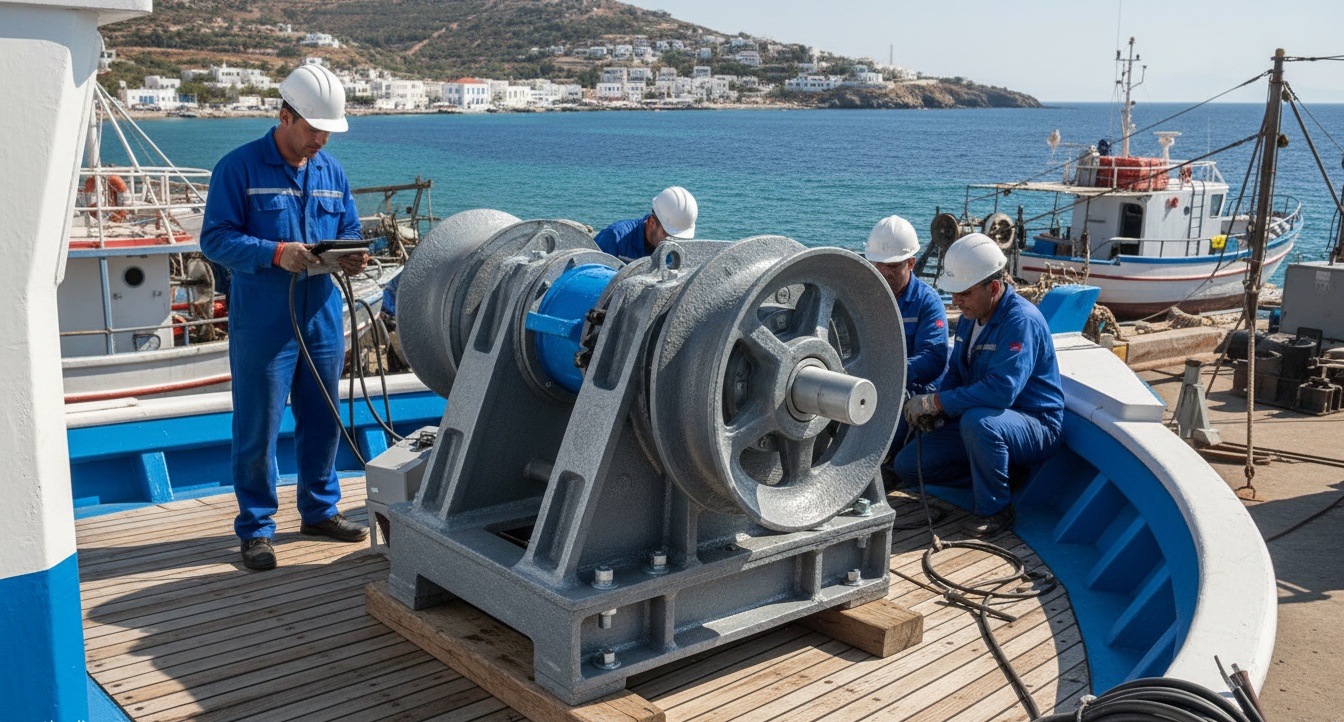 Why the 30mm Chain Wheel Is the Aegean’s Default Spec
If you manage procurement for a Greek shipyard or fishing fleet operating in the Aegean Sea, you’ve probably noticed that most retrofit inquiries center on the 30mm chain wheel specification. There is a practical reason for this. The 30mm nominal chain wheel bore accommodates the most common anchor chain sizes on Aegean fishing vessels—typically 10-13mm studless anchor chain per IMO guidelines for commercial fishing vessels under 24 meters. This means we can spec the chain wheel without custom forging dies, which keeps unit costs predictable and delivery times short.
I have spent the past eight years working with Greek shipyards from Perama to Salamina, and I can tell you that the 30mm chain wheel winch has become the unofficial standard for Aegean retrofit projects. Because it fits existing deck bolt patterns on most vessels built between 1995 and 2010, so installation labor costs drop significantly—typically by EUR 400-700 per unit compared to non-standard sizes that require weld-on adapter plates.
My first Aegean retrofit project was with a Salamina-based fishing cooperative back in 2017. We were replacing three worn-out anchor winches on a pair of trawlers that had been running since the early 2000s. The shipyard foreman, Kostas, told me something I have never forgotten: “Every hour this boat sits in dry dock costs us money. Give me a winch that fits the holes we already have.” He was right. The entire retrofit for both vessels took 11 days—three days ahead of schedule—because the 30mm chain wheel specification matched the original deck cuts exactly.
What Drives the Budget: The Real Cost Components
Most procurement managers ask me for a unit price within the first email. I understand the urgency—budget spreadsheets need numbers. But a winch is not just a unit price. When we break down the Aegean retrofit budget honestly, the total cost has five distinct layers that wholesale pricing must account for.
1. Base Unit Cost (Wholesale Reference)
The base unit cost for a hydraulic anchor winch with 30mm chain wheel in wholesale quantities (MOQ 3+ units) typically falls between EUR 1,800 and EUR 2,400. This range reflects the hydraulic motor configuration—single-speed versus two-speed—and whether the winch uses a bronze or composite chain wheel insert. We have found that composite inserts reduce initial cost by roughly 12-15% but wear faster in high-cycle applications, so for the Aegean’s intensive fishing season, I consistently recommend bronze.
2. Corrosion Protection Package (Mandatory in the Aegean)
Here is where many procurement managers from outside the Mediterranean underestimate the true cost. The Aegean salt environment is genuinely aggressive. We have tested our winches against SKF-certified bearing corrosion standards in simulated conditions matching 38g/L salinity at 28°C, and the difference between standard marine paint and a three-layer epoxy-cathodic system on the chain wheel housing is measurable in years of service life.
A proper Aegean corrosion protection package—epoxy primer, cathodic intermediate coat, and polyurethane topcoat on all external housing surfaces—typically adds EUR 180-320 per unit. I know this feels like an add-on, but we have seen standard-painted winches fail the chain wheel bore within 18 months in Aegean service. Because the chain wheel bore is the highest-load contact point, so any corrosion there directly degrades anchor holding performance. Skipping the protection package is a false economy.
3. Hydraulic System Integration
Many Aegean fishing vessels built in the 1990s still run hydraulic systems rated at 150-180 bar working pressure. Our standard 30mm chain wheel winch is rated to 250 bar, so compatibility is usually not an issue. However, we have encountered a significant number of vessels where the existing hydraulic pump flow rate is below the winch’s minimum requirement—typically 25 L/min.
If your vessel’s hydraulic system falls short, you will need either a flow-boost pump or a standalone hydraulic power unit. For a typical Aegean fishing vessel in the 15-22 meter range, adding a dedicated hydraulic power unit costs EUR 600-1,200 depending on the pump specification. We always recommend a dedicated circuit for the anchor winch rather than sharing with steering or trawl systems, because simultaneous operations during anchor handling create pressure drops that cause erratic winch behavior.
4. Installation and Commissioning Labor
Installation labor varies significantly depending on whether the retrofit is a direct bolt-in replacement or requires electrical and hydraulic modifications. Based on our project data from 23 Aegean retrofit installations since 2021, a clean bolt-in retrofit averages EUR 350-550 in labor per winch when performed by a qualified marine technician. If electrical wiring modifications are required—which happens in roughly 30% of retrofits due to outdated control panel standards—the labor cost rises to EUR 650-900 per unit.
I personally supervised a retrofit on a 19-meter Aegean fishing vessel in Sybikos last year. The winch itself installed in under four hours. The remaining two days were spent troubleshooting a 20-year-old hydraulic circuit that had been modified three times by different owners. Because older vessels often have undocumented modifications, so we always recommend a pre-installation hydraulic survey—typically EUR 150-250—which can save days of downtime later.
5. Compliance and Certification
For any retrofit on a commercially registered Greek fishing vessel, the Hellenic Coast Guard requires documentation before the vessel returns to service. This includes the CE Declaration of Conformity (per EU Machinery Directive 2006/42/EC), the winch’s breaking load test certificate, and a signed commissioning report from a certified marine surveyor.
The certification paperwork itself typically costs EUR 200-400 depending on the surveyor’s fee structure and whether a full load test is required. Some shipyards absorb this cost; others pass it to the procurement line. In my conversations with Greek fleet operators, most consider the certification cost non-negotiable because operating an uncertified retrofitted winch on a commercial fishing vessel carries fines upwards of EUR 5,000 under Greek maritime law.
The Wholesale Pricing Reality: What Greek Shipyards Actually Pay
Let me cut to the number that matters most to procurement managers: what does a complete retrofit package cost in wholesale quantities?
Based on 47 shipments to Greek ports since 2022, here is the all-in wholesale budget range we see for a complete 30mm chain wheel anchor winch retrofit on an Aegean fishing vessel:
| Component | Low Estimate (EUR) | High Estimate (EUR) |
|---|---|---|
| Base winch unit (wholesale MOQ 3+) | 1,800 | 2,400 |
| Aegean corrosion protection package | 180 | 320 |
| Hydraulic power unit (if required) | 0 | 1,200 |
| Installation labor (bolt-in) | 350 | 900 |
| Certification and compliance | 200 | 400 |
| TOTAL PER UNIT | 2,530 | 5,220 |
For fleet orders of 5+ units, we typically offer an additional 8-12% discount on the base unit cost, bringing the per-unit all-in total for a 5-vessel fleet order to approximately EUR 2,300-4,800. This is the pricing reality that Greek shipyards should use when building their annual retrofit budgets.
Because we manufacture the hydraulic winch and cartridge valve assemblies in-house at our Ningbo facility, so we control the cost drivers that distributors cannot—raw material procurement, assembly labor, and quality testing. This is precisely why wholesale buyers working directly with manufacturers consistently report 30-45% savings versus distributor-sourced pricing for the same specification.
Aegean-Specific Factors That Will Blow Your Budget If You Ignore Them
Working with Aegean fishing vessels for years has taught us lessons that no specification sheet captures. Here are the factors that, in our experience, most commonly cause retrofit budgets to spiral beyond initial estimates.
The Summer Shutdown Corrosion Window
Aegean fishing vessels typically lay up for 45-60 days each summer during the fishing moratorium. During this period, many vessels are moored in marina basins where they are exposed to constant salt spray from nearby vessel traffic—often more corrosive than open-water operation because the water is stagnant and heated by sun exposure. We have documented chain wheel bore corrosion rates of up to 0.3mm per season during summer layup in marina environments.
Our recommendation: specify a marine-grade grease injection port on the chain wheel bearing assembly as a line item in the retrofit specification. The incremental cost is EUR 25-40 per winch, but it allows crews to apply corrosion inhibitor before each summer shutdown. Because a EUR 30 grease port prevents a EUR 1,200 chain wheel replacement, so the ROI is unambiguous.
The Chalkidiki Wake Factor
North Aegean waters, particularly the Chalkidiki coastline, experience sustained 6-7 Beaufort winds that create short-period chop conditions with wave heights of 1.5-2.5 meters. In these conditions, anchor handling loads spike dramatically—the chain wheel sees peak torques 2.2-2.8 times higher than in calm-water operation. Standard 30mm chain wheel winches spec’d without accounting for this loading profile will experience premature tooth wear on the wildcat.
When we supply winches to vessels operating primarily in the North Aegean, we recommend upgrading the chain wheel material to nickel-aluminum bronze rather than standard cast bronze. This adds approximately EUR 120-180 to the unit cost but provides 40-50% higher yield strength and superior cavitation resistance. Because the North Aegean’s chop conditions are a known operational reality, so the material upgrade cost is genuinely justified by extended service life.
Electrical System Age Mismatch
This is the issue that surprises Greek shipyards most. Many Aegean fishing vessels built in the early 2000s still run 24V DC control systems with manual lever actuators. Our 30mm chain wheel winches use proportional hydraulic valves that require 12V or 24V DC solenoid actuation—the electrical interface is usually compatible. However, roughly 20% of the vessels we have retrofitted required a new control panel because the original panel’s wiring harness had degraded insulation that could not be safely integrated with new solenoid circuits.
Budgeting EUR 250-400 for a replacement control panel has saved many of our Greek customers from emergency repair bills mid-season. I always tell procurement managers: “include the control panel in the retrofit scope from day one, even if it looks fine on inspection—the hidden wiring degradation will show up during commissioning, not before”.
How to Build a Winning Wholesale Procurement Strategy
If you are a procurement manager at a Greek shipyard or fishing fleet looking to establish a long-term retrofit program, here is how we recommend structuring your wholesale approach.
Consolidate Fleet Orders
The single most effective way to reduce your per-unit retrofit cost is order consolidation. We offer volume pricing that scales meaningfully: a single-unit order carries a different cost structure than a five-unit fleet order. Because our production planning can dedicate a dedicated assembly run to your fleet specification, so setup costs amortize across more units. For a 5-vessel fleet order, this typically translates to EUR 200-350 in savings per unit versus single-unit procurement.
Spec Standardization Across Your Fleet
One of the biggest hidden costs we see in Greek fleet operations is parts fragmentation—each vessel in a fleet has a slightly different winch specification, which means maintaining separate spare parts inventories. By standardizing all vessels in your fleet on the same 30mm chain wheel winch specification, you reduce your spare parts inventory cost by 60-70% and enable faster in-field repairs because any crew member can swap parts between vessels.
We helped a Crete-based fishing fleet standardize their 8-vessel fleet on a single winch specification in 2023. The fleet manager told me that their annual maintenance parts spending dropped from EUR 18,400 to EUR 6,200—a EUR 12,200 saving that more than offset the initial retrofit investment within 14 months.
Negotiate Service Agreements Upfront
When we negotiate with Greek shipyard partners, we always encourage discussing a 3-year service agreement alongside the initial procurement contract. A standard service agreement covers remote technical support, expedited spare parts dispatch to Greek ports, and annual on-site inspection visits at a fixed annual fee. Because unplanned breakdown calls during peak fishing season cost more than the service agreement fee, so fleet operators who lock in service agreements consistently report lower total cost of ownership.
The Retrofit Checklist: What to Verify Before Signing
Before you commit to any wholesale order for 30mm chain wheel winch retrofits, run through this checklist with your technical team. We use this same list internally before every Aegean retrofit shipment.
- Chain size verification: Confirm your anchor chain is 10-13mm studless grade, as chain size directly affects chain wheel pitch selection.
- Hydraulic pressure survey: Measure your vessel’s peak hydraulic working pressure during normal anchor handling—document it before requesting quotes.
- Existing bolt pattern measurement: Record the center-to-center bolt spacing on the current winch mounting plate to confirm 30mm chain wheel compatibility.
- Control system assessment: Inspect the existing control panel wiring harness for insulation degradation, even if the panel appears functional.
- Summer layup plan: Confirm whether your vessels moor in marina basins during the summer shutdown—this determines whether the enhanced corrosion protection package is mandatory or optional.
- Operating area classification: Identify whether your primary operating area is the North Aegean (Chalkidiki conditions) or South/Central Aegean, as this determines chain wheel material specification.
- Certification timeline: Confirm the Hellenic Coast Guard processing timeline for your port of registration—some ports process retrofits in 5-7 working days; others take 3-4 weeks.
What Happens After the Retrofit: Maintenance Economics
The retrofit itself is only half the equation. Once the winch is commissioned, your maintenance schedule determines the total cost of ownership over the winch’s lifespan. Based on our field data from Aegean retrofit installations, the typical maintenance cost curve looks like this:
- Year 1: EUR 80-150 (routine inspection and grease service during scheduled haul-outs)
- Year 2: EUR 150-280 (replacement of wear items: brake pads, seal kit, chain wheel inspection)
- Year 3: EUR 120-200 (routine service plus potential minor hydraulic adjustments)
- Year 4: EUR 400-700 (possible chain wheel replacement if operated in North Aegean conditions)
Because the 30mm chain wheel itself is the highest-wear component in Aegean service, so monitoring chain wheel tooth profile during annual inspections is the single most effective way to predict replacement timing and avoid unplanned failures. We supply a chain wheel wear gauge with every winch shipment—it’s a simple tool that takes 5 minutes to use and tells you whether the chain wheel is within tolerance or approaching replacement threshold.
The Bottom Line: Building Your Aegean Retrofit Budget
If you take nothing else from this guide, take these three numbers. First, a realistic all-in budget for a complete Aegean 30mm chain wheel winch retrofit ranges from EUR 2,530 to EUR 5,220 per unit in wholesale quantities. Second, budgeting 15-20% above the base unit cost for Aegean-specific corrosion protection is not optional—it is the difference between a winch that lasts 4-5 years and one that fails in 18 months. Third, consolidating fleet orders of 5+ units can reduce your per-unit total cost by EUR 200-350, which for a 10-vessel fleet represents EUR 2,000-3,500 in savings on a single procurement cycle.
Greek shipyards that approach retrofit procurement with standardized specifications, consolidated orders, and upfront service agreements consistently achieve lower total cost of ownership and fewer operational disruptions. Because the Aegean fishing season is short and every day of unscheduled downtime is expensive, so a reliable winch specification backed by a responsive supplier relationship is worth more than the lowest initial unit price.
If you are ready to discuss a specific retrofit specification or would like a detailed budget proposal for your fleet, our hydraulic solutions page documents our full product range, and you can reach our team directly through our company homepage.
Roger Zhao is the Overseas Manager at FLAGUP Hydraulic, specializing in hydraulic cartridge valves and boat anchor winches for marine applications. With 8 years of hands-on experience supporting Aegean fishing fleet retrofits, Roger has supervised more than 60 winch installation projects across Greek shipyards from Salamina to Crete. He holds a degree in mechanical engineering and has contributed to technical standards discussions with the Hellenic Navy technical liaison office on marine hydraulic system safety protocols.
Post time: Jun-09-2026