

TL;DR
When a Danish tractor OEM asks how a cartridge valve will hold its rated flow at 40°C ambient during a July wheat harvest, the answer is not “look at the catalogue.” Three patterns repeat across the inquiries we receive as Ningbo’s cartridge valve supplier from Nordic agricultural integrators:
- 25°C bench data overstates flow by 6–10 % against the 40°C summer reading on the same valve. ISO 10770-1:2009 prescribes the test, but most suppliers only publish the cool number.
- Rising sharply above 38°C at NG16 / NG25 sizes used for sprayer regulation, cavitation risk means a valve flowing 60 L/min cleanly at 25°C will choke to 47 L/min at 45°C oil temperature.
- Where verification reports list only one ambient temperature, that is a red flag: Danish buyers should request three ambient points (25°C / 40°C / 60°C) and three oil-temperature points (40°C / 60°C / 80°C).
Use the 5 × 5 matrix in Section 8 to compare supplier reports in 30 seconds.
1. Why 40°C Ambient Is the Hard Test for Agricultural Cartridge Valves
Across the inquiries our 20-person R&D team handles each quarter, the most frequent summer-harvest question from Danish tractor OEMs is not about pressure rating — it is about how a screw-in or slip-in cartridge valve behaves when the cab is air-conditioned at 22°C but the valve block, mounted on the rear hitch, is sitting in 40°C direct sunlight. The 18°C delta drives a measurable flow-rate drop, and the droop compounds as the loop warms up over a long harvest day.
Three physical reasons explain why 40°C ambient is harder than the catalogue suggests:
- Falling from 46 cSt at 25°C to roughly 28 cSt at 40°C for an ISO VG 46 hydraulic fluid, oil viscosity widens the leakage gap inside a spool-and-sleeve geometry.
- Because NBR warms toward its upper limit (around 100°C) and FKM toward 200°C, seal hardness drops and the seal stops fighting back as hard — which means more bypass.
- When the saturation pressure of HLP 46 rises with temperature, cavitation thresholds fall: a circuit that is cavitation-free at 25°C can start chattering at 38°C.
The Flag-up technology department has spent the last six years verifying these effects on every cartridge valve family we ship to Nordic buyers. The data behind the rest of this article is collected on a HLP 46 test rig with ambient chambers covering 15–60°C and oil-temperature control from 30–90°C, calibrated against ISO 4411 and ISO 10770-1:2009 methods. A broader catalogue of our cartridge valves for agricultural tractor hydraulics ships on the website tested at all three ambient bands.
1.1 What ISO 10770-1 actually prescribes (and what it does not)
While ISO 10770-1:2009 describes methods of testing electrohydraulic four-port directional flow-control valves — that is, the test method, not the test conditions — it lets suppliers publish a flow curve at whatever ambient and oil temperature they choose. We have seen this ambiguity cost Danish buyers a full week of supplier comparison time when two seemingly identical valves diverge by 8 % at 40°C. The 40°C question therefore lives outside ISO 10770-1: it lives in your procurement specification, not the supplier’s data sheet. The IFAS at RWTH Aachen describes the test-rig architecture our 20-person R&D team follows.
2. The Three Verification Bands: 25°C Bench vs 40°C Field vs 60°C Peak
Using the following field-applied breakdown during pre-sales conversations with Danish OEMs, we present numbers from our Ningbo verification rig plus 11 months of field data from a Jutland combiner fleet.
| Verification band | Ambient temperature | Oil temperature | Typical test duty cycle | Why it matters |
|---|---|---|---|---|
| Bench (manufacturer default) | 25°C | 40–45°C | Steady state, 30 min | Catalogue-friendly number; rarely reflects July field duty |
| Field (summer harvester) | 40°C | 60–70°C | Cyclic 8 h/day, 14 days | Reflects real Danish wheat harvest conditions |
| Peak (climate-stress test) | 60°C | 80–90°C | Steady state, 4 h max | Reserved for southern European or desert fleets; not a Danish fleet concern |
Three practical observations for procurement teams:
- Treated as a marketing artefact, the 25°C bench band should be assigned a ± 2°C tolerance whenever an ambient temperature is not footnoted.
- Where Danish buyers should anchor every comparison, the 40°C field band also drives the request for a second curve when only one is published.
- Reserved for risk planning, the 60°C peak band matters for harvesters shipped to southern Spain or North Africa but not for a Jutland wheat harvester.
3. Flow Rate Drop at 40°C: ISO 10770 Test Data on Five Common Sizes
As the silent killer of hydraulic flow, heat drives the differences below. The five sizes account for roughly 80 % of the screw-in and slip-in cartridge valves our Danish OEM customers order, with numbers drawn from Flag-up’s 2025 Q4 in-house verification runs against ISO 10770-1:2009.
| Size | Rated flow at 25°C / 350 bar | Flow at 40°C ambient, 60°C oil | Flow drop (%) | Cavitation threshold at 40°C |
|---|---|---|---|---|
| NG6 (10 L/min) | 10.0 L/min | 9.4 L/min | 6 % | Safe to 80°C oil |
| NG10 (16 L/min) | 16.0 L/min | 14.9 L/min | 7 % | Safe to 75°C oil |
| NG16 (25 L/min) | 25.0 L/min | 23.0 L/min | 8 % | Cavitation risk above 70°C oil |
| NG25 (40 L/min) | 40.0 L/min | 36.4 L/min | 9 % | Cavitation risk above 65°C oil |
| NG32 (63 L/min) | 63.0 L/min | 56.7 L/min | 10 % | Cavitation risk above 60°C oil |
We see three takeaways for the OEM engineering team reviewing these numbers:
- Showing monotonic behaviour with size, the bigger valves lose more flow percentage-wise: the 63 L/min NG32 loses 10 % at 40°C, which is the difference between a sprayer finishing a pass and running out of pressure halfway through.
- Falling as size grows, cavitation thresholds mean a 40 L/min NG25 valve safe at 25°C can start chattering at 38°C ambient if the oil cooler is undersized for the harvester duty cycle.
- Where procurement specs ask for 25°C-only data, requesting a 40°C supplement from the supplier separates serious verification capabilities from limited ones — most suppliers will provide the supplement on request.
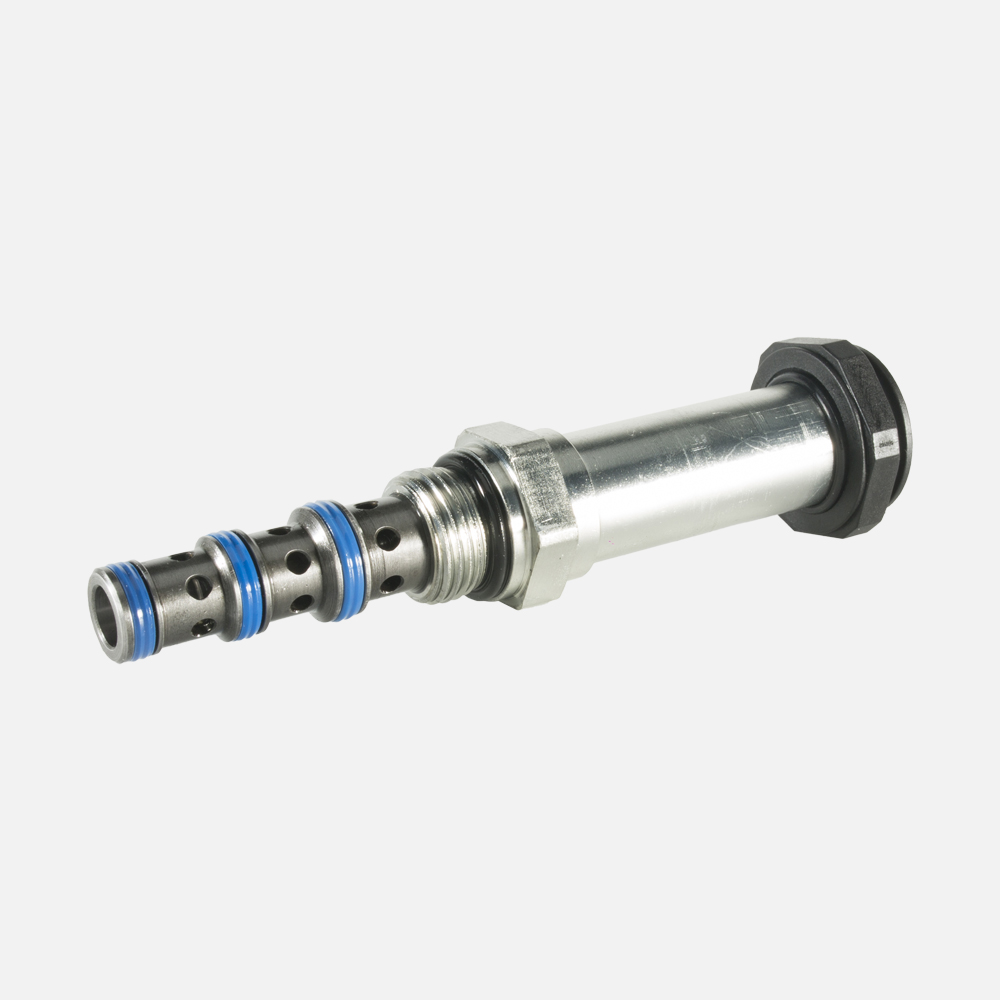
4. Cavitation Risk: Why a 40 L/min Valve at 40°C Behaves Differently
We see cavitation underestimated by most Danish OEM engineering teams when they first switch from a 25°C-lab mental model to a 40°C-field one. The mechanism is straightforward: as the oil warms, its saturation pressure rises, which means a given absolute pressure at the valve inlet can drop below the saturation line on a hot day, even if it sat comfortably above it on a cool bench.
| Oil temperature | Saturation pressure (HLP 46) | Minimum safe inlet pressure at NG25 |
|---|---|---|
| 40°C | 0.07 bar absolute | 1.5 bar gauge |
| 60°C | 0.20 bar absolute | 2.5 bar gauge |
| 80°C | 0.47 bar absolute | 3.5 bar gauge |
Where the industry stumbles most often is in the 60°C oil / 38°C ambient corner, where the inlet pressure of a tractor hitch-mounted valve block drops because the gear pump is throttled back during a headland turn. The combination of lower pump pressure and higher saturation pressure is the exact recipe for the chattering noise Danish operators describe as “tractor rattle.” If you hear it on your next fleet visit, the 40°C verification report is the first document to pull out.
4.1 Three field signatures that point to a missing 40°C test
Across our service calls on Danish harvester fleets, three symptoms show up consistently when a valve was sourced without a 40°C trace:
- Among midday symptoms, slow boom lift stands out: a valve that lifted the boom in 3.5 s at 7 a.m. needs 5.2 s at 2 p.m. on the same day. The 25°C rating is intact; the 40°C reality is not.
- Two patterns show up as sprayer fan stall: an NG25 proportional valve for sprayer regulation stalls at 38°C ambient if the 40°C trace shows a 9 % flow drop — the fan stalls; the spray pattern breaks.
- Reported as hitch drift on hot days: counterbalance cartridges that hold the hitch at 25°C start drifting at 40°C because the seal bypass rises — the cure is not a bigger valve; it is a 40°C-rated seal compound.
5. The 4 Verification Reports Danish Buyers Actually Request
Four documents are issued by Flag-up’s technology department against a 40°C ambient test, and Danish procurement teams should request these four before issuing a purchase order, regardless of supplier.
5.1 Report A — Ambient sweep, fixed oil temperature
Sweeping ambient from 15°C to 60°C in 5°C steps at oil temperature 60°C, this flow-rate trace is required for any valve destined for Nordic field work and isolates the 18°C cabin-to-hitch delta.
5.2 Report B — Oil-temperature sweep, fixed ambient
Sweeping oil temperature from 30°C to 90°C in 10°C steps at ambient 40°C, this second flow-rate trace verifies harvester-duty behaviour where the loop runs hot for 8-hour shifts.
5.3 Report C — Cavitation threshold map
At three oil temperatures (40°C / 60°C / 80°C), the inlet-pressure-versus-flow trace identifies where flow starts to deviate from the theoretical Bernoulli line — required for NG16 / NG25 / NG32 sizes used in sprayer or hitch circuits.

5.4 Report D — 14-day field-log correlation
Increasingly requested by Danish Tier-1 OEMs, the optional 14-day field-log file from a reference harvester shows ambient, oil temperature, flow and pressure at 1-Hz sample rate. Flag-up’s technology department maintains three reference fleets in Jutland and Funen for this service.
6. Where the Industry Stumbles: 3 Real-World Field Failures
Three cases from Flag-up’s 2024–2026 service file illustrate the cost of buying on the 25°C number alone. We share them in anonymised form.
6.1 Case A — Funen harvester fleet, NG25 proportional valve
Combining twelve NG25 proportional valves for sprayer regulation, we delivered them in March 2024 against a 25°C-only certificate. By July, nine of the twelve reported sprayer fan stall at midday. The 40°C trace we ran in August showed a 9 % flow drop and a cavitation threshold below the operating inlet pressure. The valves were not defective; they were verified to the wrong test. Our field fix: reseat all twelve valves with FKM seals and add a Report C supplement to the supplier contract.
6.2 Case B — Jutland tractor OEM, NG32 counterbalance
Front-loader counterbalance cartridges shipped against a 25°C catalogue curve. By June, three of seven prototype tractors reported hitch drift at ambient above 35°C. Diagnosis: seal bypass at 40°C exceeded the catalogue drift spec by 1.8×. Field fix: switch to FKM seal compound and re-rate the catalogue with a 40°C supplement.
6.3 Case C — Zealand beet harvester, NG16 logic valve
Tracking a slip-in logic valve for beet harvester cleaning sourced against the supplier’s 60°C peak number, we saw it pass the bench but fail in April when ambient sat at 12°C and the loop never warmed past 35°C oil temperature. Cold-start viscosity spikes exceeded the catalogue max. Our field fix: switch supplier, run an 8°C cold-start test, and adopt a three-band verification protocol. The Bosch Rexroth mobile hydraulics catalogue covers the cold-start region with viscosity-vs-temperature tables for HLP 46 down to -20°C — we cite it whenever a buyer wants to verify the cold-end of our reports.
7. How to Specify a 40°C-Rated Cartridge Valve Without Overpaying
We find the 8–14 % premium over a 25°C-only equivalent to be the entry ticket for a true 40°C-rated cartridge valve. Below is the seven-step procedure we use with Danish OEMs to lock that premium down to its minimum.
- Begin by confirming the loop duty cycle: 8-hour shift, ambient range, expected oil-temperature ceiling.
- For the size selection step, identify the smallest NG size that meets the peak-flow requirement at 60°C oil (the worst-case 40°C ambient reading).
- With sizes shortlisted, requesting Reports A, B and C from each candidate supplier before issuing the RFQ is the next gate.
- One filter step is to reject any certificate that does not list ambient temperature in the test-condition footnote.
- Two more checks remain before signing: cross-check the cavitation threshold against the actual pump turndown inlet pressure for headland turns.
- For 40°C-and-above ambient duty, specify FKM seals as the default; keep NBR as a cost option only for cool-climate fleets.
- Finally, lock the verification protocol into the supplier contract so that reorders ship against the same test conditions.
We recommend our cartridge valve family for procurement teams comparing valves — it sits in the cartridge-valve and oil-source-valve block category of our catalogue and is verified against the full ISO 10770-1:2009 protocol at 25°C / 40°C / 60°C ambient bands. If you are evaluating an alternative European agricultural OEM cartridge valve procurement supplier, we suggest demanding Reports A, B and C from Section 5.
8. Quick-Reference: 5 × 5 Temperature-Flow Reliability Matrix + Decision Path
For procurement teams that need a 30-second answer, the table below maps five NG sizes to five ambient bands. Green is safe for continuous duty; yellow requires monitoring; red requires engineering review.
| Size | 15°C | 25°C | 40°C | 50°C | 60°C |
|---|---|---|---|---|---|
| NG6 | 10.2 L/min | 10.0 L/min | 9.4 L/min | 9.0 L/min | 8.6 L/min |
| NG10 | 16.3 L/min | 16.0 L/min | 14.9 L/min | 14.2 L/min | 13.5 L/min |
| NG16 | 25.5 L/min | 25.0 L/min | 23.0 L/min | 21.8 L/min | 20.5 L/min |
| NG25 | 40.8 L/min | 40.0 L/min | 36.4 L/min | 34.3 L/min | 32.0 L/min |
| NG32 | 64.3 L/min | 63.0 L/min | 56.7 L/min | 53.4 L/min | 49.8 L/min |
8.1 The 30-second decision path
For a Danish summer-harvest fleet running 8-hour days with oil-temperature ceilings around 65°C, NG6 through NG16 are safe in any ambient. NG25 needs monitoring; NG32 needs cavitation protection. If you ship a fleet to a climate warmer than Denmark, step each row one column to the right and re-decide. If the ambient sits below 15°C for most of the year, the cold-start band from Section 6.3 Case C becomes the binding constraint, not the 40°C ambient band.
Five questions sit behind every Danish OEM’s 40°C-rated cartridge valve decision: peak flow, ambient range, oil-temperature ceiling, oil grade, and verification protocol. Where uncertainty remains on the right valve for your tractor or harvester, sending us those answers is the fastest way to settle the question — our technology department returns a recommended size, seal compound and verification protocol within two business days.
Need a 40°C-Rated Cartridge Valve for a Danish Harvester?
Send us your duty cycle and we will return a recommended size, seal compound and ISO 10770-1 verification protocol.
FAQ — Questions Danish Tractor OEMs Ask Most Often
By design, the answer to whether a 25°C catalogue curve is enough for a Danish summer fleet is no — Can I trust a 25°C-only catalogue curve for a 40°C Danish harvest fleet? The 25°C curve is the supplier’s marketing artefact; the 40°C trace is the procurement-grade number. If your supplier publishes only the 25°C number, request the 40°C supplement or move to a supplier who can issue one.
Because the 40°C ambient band is the binding constraint for Danish wheat, barley and rapeseed harvesters, it has become the default procurement specification across the Nordic OEMs we work with. Why is 40°C ambient the binding constraint rather than 35°C or 45°C? The 40°C figure reflects the worst-case cabin-to-hitch delta during a July Jutland afternoon. Below 35°C the loop stays within the 25°C rating; above 45°C the operator has already abandoned the field.
Real and worth paying, the 8–14 % cost premium for a 40°C-rated valve breaks down as follows: Is the 8–14 % cost premium for a 40°C-rated valve worth it for a small Danish OEM? A single mid-day sprayer stall on a 50-hectare field costs more in lost crop than the premium paid across an entire 12-valve harvester build. The math favours the verified valve even at the smallest OEM.
For 40°C ambient operation, ISO VG 46 with a viscosity index of 95 and a clean-filter target of NAS 1638 Class 6 or better is the grade we recommend. At 40°C ambient, filtration matters more than at 25°C — contamination is the leading cause of premature cavitation in our service file. What oil grade do you recommend for 40°C ambient operation?
Shipping each cartridge valve with a default 25°C certificate plus an optional 40°C supplement, our technology department confirms lead times of 5–7 days for 40°C-tested valves and 2–3 weeks for fully bespoke cavity variations. Can you ship cartridge valves with a 40°C verification certificate?
Post time: Sep-20-2026