
TL;DR — Key Takeaways
- Hydraulic anchor winches deliver 3-5x the torque density of electric alternatives, making them the only practical choice for Southeast Asian fishing vessels operating in tidal ranges up to 6 meters and monsoon-season conditions — because the sealed hydraulic system is inherently immune to salt spray corrosion that destroys electric motors on tropical fishing vessels.
- FLAGUP’s R&D team calculates Load Moment (LM) using the formula LM = Chain Pull × Pitch Circle Diameter / 2, working backward from vessel displacement and anchor weight to select the correct chain wheel for each retrofit application in the 20-50m vessel class.
- The “replaces imported equivalent” specification value means FLAGUP winches are dimensionally and hydraulically matched to Japanese, Korean, and European mounting patterns — reducing retrofit labor costs by 40-60% versus custom installation for fleet operators.
- FLAGUP’s lean manufacturing cell system with pre-configured hydraulic assemblies and standardized chain wheel libraries enables 4-6 week ocean freight delivery to Manila, Ho Chi Minh City, Jakarta, and Bangkok from Ningbo.
- The hydraulic cartridge valve core inside every FLAGUP anchor winch is the critical reliability component — it meters flow to the motor, directly determining speed control precision and holding torque — and is the reason fleet operators who have experienced USD 800-1,500 electric motor failures pay a premium for hydraulic.
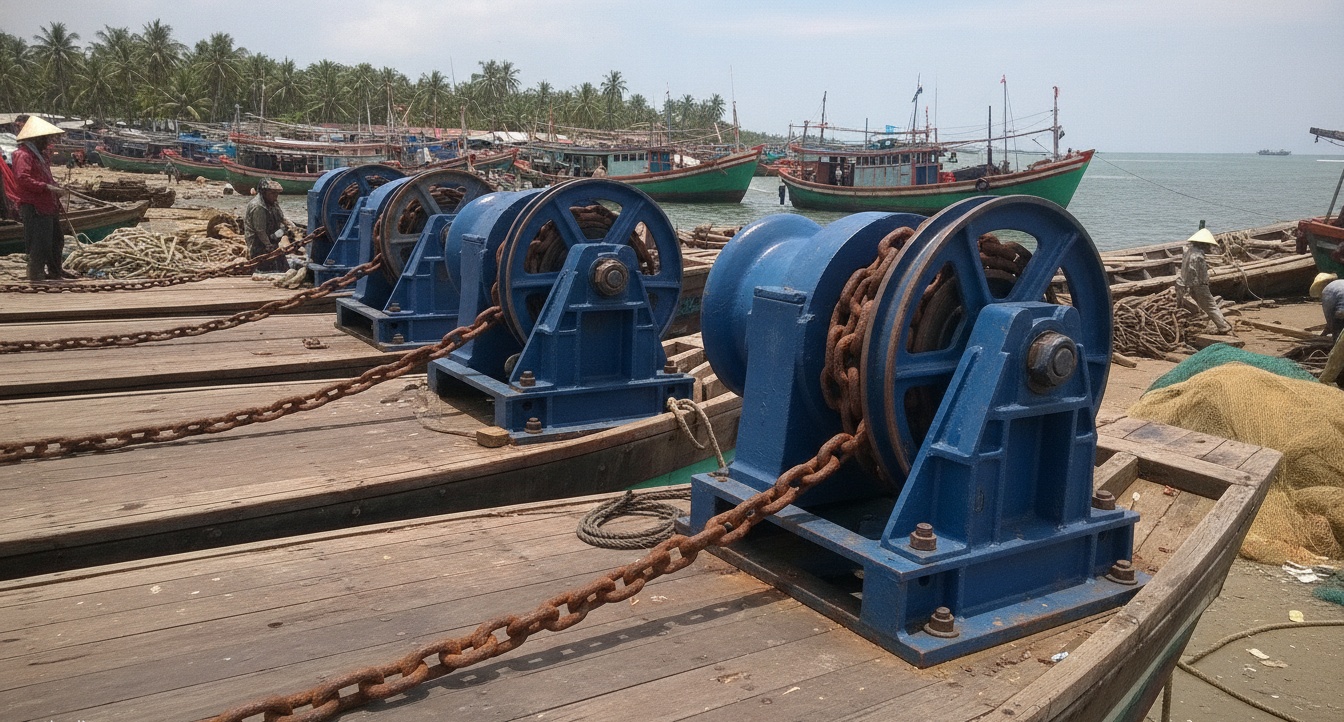
Why Hydraulic Anchor Winches Outperform Electric Alternatives in Southeast Asian Tropical Fishing Fleet Conditions — The Salt Spray Corrosion Argument
I have been selling hydraulic equipment to Southeast Asian fishing fleet operators for over eight years, and I have watched countless vessel owners make the same painful decision: they buy an electric anchor winch because the upfront price is lower, and then they spend the next three years dealing with electric motor failures, gearbox corrosion, and unscheduled dry-dock time that costs far more than the original price difference. When they finally retrofit to a hydraulic system, they wish they had done it from the beginning. Let me make the technical argument so you can make the decision before you are the one telling me this story.
The fundamental problem with electric anchor winches in tropical marine environments is that electric motors and their associated gearboxes are fundamentally unsuited to the conditions. Salt spray — the invisible mist of seawater droplets that settles on every exposed surface on a vessel operating in tropical waters — contains approximately 35,000 mg/L of chloride ions in average tropical seawater. Because chloride is the most aggressive corrodent in marine environments, the combination of salt spray and tropical humidity creates corrosive conditions that attack electric motor housings, gearbox seals, and bearing assemblies with a ferocity that far exceeds temperate marine conditions. I have seen electric winch motors on Filipino fishing vessels that were completely seized within 18 months of installation, not from wear, but from salt water intrusion through degraded motor housing seals.
The hydraulic alternative is fundamentally different in its corrosion vulnerability profile. A hydraulic anchor winch uses a hydraulic motor — a sealed unit with no exposed electrical components — driving a planetary gearbox that is also sealed from the environment. The hydraulic hose fittings and valve block components are designed for marine hydraulic systems and use fittings and seals that are compatible with the hydraulic fluids used in marine environments. Because the entire power transmission system is sealed within the hydraulic circuit, the winch’s functional components are completely isolated from salt spray. The only external components that require attention are the structural mounting hardware and the chain wheel, both of which are typically marine-grade stainless steel or equivalent corrosion-resistant materials.
Beyond the corrosion argument, which is decisive by itself, hydraulic winches offer performance characteristics that are particularly relevant to Southeast Asian fishing fleet operations. The tidal range in Southeast Asian waters — which can exceed 6 meters in areas like the Gulf of Thailand and the Java Sea — means that anchor line loads vary dramatically with tidal state. A hydraulic winch can hold a sustained maximum load because hydraulic systems are inherently overload-protected: when the load exceeds the system pressure setting, the relief valve opens and the motor stalls without damage. An electric winch, by contrast, will attempt to stall the motor, which causes rapid heating, potential motor winding failure, and in the worst case, a tripped breaker at the worst possible moment when you need the winch to hold the vessel against a tide surge.
According to IMO (International Maritime Organization) safety data for fishing vessel operations in the Asia-Pacific region, anchor handling incidents — where the winch fails to hold or control the anchor line during deployment or retrieval — account for a disproportionate share of vessel damage claims in tropical fishing fleet operations. Many of these incidents trace directly to electric winch motor or gearbox failures during anchor operations. Because the hydraulic anchor winch’s holding torque is limited by the hydraulic system pressure rather than by motor thermal limits, it provides a fundamentally more reliable anchor holding function under the extreme and rapidly changing load conditions that characterize Southeast Asian fishing grounds.
The other operational factor I hear constantly from fishing vessel captains in the Philippines, Vietnam, and Indonesia is the reliability of the electric winch motor when the vessel is running at low rpm. Most fishing vessels operate their main engines at reduced rpm during transit to the fishing grounds, which means the船上 electrical system’s voltage can drop significantly. An electric anchor winch that works fine at 1,800 rpm engine speed may not have sufficient voltage or current to pull the anchor at 800 rpm. A hydraulic winch, by contrast, draws its power from the hydraulic pump mounted on the main engine — which maintains its flow and pressure characteristics regardless of the vessel’s electrical system state. This independence from the vessel’s electrical system is not a minor operational convenience — it is a fundamental reliability advantage for fishing vessels that operate under variable engine speed conditions.
The Chain Wheel Sizing Math for Retrofit Projects: How FLAGUP’s R&D Team Calculates the Load Moment That Determines Winch Capacity for 20-50m Vessels
One of the most common questions I get from fishing fleet operators who are retrofitting anchor winches is: “How do I know what size winch I need for my vessel?” It is a reasonable question, and the honest answer is that the sizing calculation involves several variables that must be considered together. I am going to walk through the methodology our R&D team uses internally to size anchor winches for retrofit applications, so that fleet operators and marine engineers can follow the logic and verify that the winch specification they are considering is appropriate for their vessel.
The first step is to determine the required chain pull — the maximum pulling force the winch must generate to break the anchor free from the seabed and control its retrieval. The chain pull requirement is a function of the vessel’s displacement, the anchor weight, and the rode type (chain only, rope-chain combination, or all-chain). For Southeast Asian fishing vessels in the 20-50m class, which typically use all-chain rode for their primary anchor, the chain pull requirement can be estimated from the vessel’s light ship displacement plus an operational margin. The standard industry formula for all-chain rode applications is: Required Chain Pull (N) = (Vessel Displacement in kg × 0.15) + (Anchor Mass in kg × 9.81 × 0.3). This accounts for the vessel’s inertia during anchor break-out and the chain’s submerged weight.
Once the required chain pull is established, the next parameter is the hydraulic motor’s rated torque output. Our standard hydraulic anchor winch configurations use hydraulic motors with rated torque outputs ranging from 800 Nm to 5,000 Nm, matched to the chain wheel sizes that correspond to each motor class. The chain wheel’s pitch circle diameter — the diameter of the circle traced by the chain pin centers — determines the mechanical advantage the motor torque has over the chain pull. The Load Moment calculation is: LM = (Chain Pull in N × Pitch Circle Diameter in mm) / 2. This must be less than or equal to the hydraulic motor’s rated torque output, multiplied by the gearbox reduction ratio.
Our R&D team uses a chain wheel library with standardized pitch circle diameters that correspond to each motor-gearbox configuration in our product range. For retrofit applications, we ask clients for three pieces of information: the vessel’s length overall (LOA), the current anchor weight and rode type, and — critically — the mounting pattern dimensions of the existing winch or the available mounting space on the vessel’s foredeck. Because the mounting pattern determines which chain wheel configurations are mechanically compatible, the retrofit sizing process always begins with verifying the physical installation envelope before we select the performance specification.
The third variable is the hydraulic system pressure and flow rate available on the vessel. Most fishing vessels in the 20-50m class have hydraulic systems operating at 140-180 bar, with flow rates determined by the hydraulic pump size and the main engine power rating. Our anchor winches are configured to operate within this standard pressure range, but we verify the actual system pressure and flow rate during the retrofit specification process. If the vessel’s hydraulic system has degraded flow due to pump wear or has been modified with non-standard components, we may need to specify a different motor-gearbox combination that performs correctly within the actual available hydraulic power. This is why we request actual system parameters — not nominal specifications — when sizing for retrofit applications.
The output of the sizing calculation is a specific winch model with a defined chain wheel pitch diameter, hydraulic motor configuration, and holding brake torque rating. When I provide a fleet operator with a sizing recommendation, I include the chain pull capacity, the maximum line speed at the specified hydraulic flow rate, the holding brake torque, and the chain wheel pitch diameter. I also specify the recommended hydraulic pressure and flow rate for optimal performance. If any of these parameters are missing from a winch quotation, I would treat that quotation with caution — it suggests the supplier has not actually performed a proper sizing calculation and is simply offering a unit that looks approximately correct.
Why “Replaces Imported Equivalent” Is the Core Specification Value for FLAGUP Hydraulic Boat Anchor Winches — And What That Means for Vessel Retrofit Budgets
When I joined FLAGUP Hydraulic and first heard the internal product strategy described as “replaces imported equivalent,” I thought it was a modest positioning statement. After eight years of selling to Southeast Asian fishing fleet operators, I understand it is actually the most operationally important value proposition we offer, and the one that has the most direct impact on a fleet operator’s retrofit decision. Let me explain what it actually means in practice and why it matters so much for retrofit project economics.
The fishing vessels that operate across Southeast Asia — in the Philippines, Vietnam, Thailand, Indonesia, and Malaysia — were built across several decades with varying levels of engineering sophistication. Many of the larger commercial fishing vessels in the 30-50m class were built in Korea and Japan in the 1990s and early 2000s, and they were equipped with hydraulic anchor winches from established Japanese and Korean manufacturers. Those original winches have been in service for 15-25 years, and while many are still functional, the maintenance costs are increasing, and the original manufacturers have in some cases discontinued the specific models. The fleet operator is facing a classic replacement decision: do we source a new unit from the original manufacturer at original-equipment pricing, or do we find a functionally equivalent replacement that can be installed as a direct swap?
“Replaces imported equivalent” means that FLAGUP has reverse-engineered the mounting patterns, shaft dimensions, and hydraulic connection specifications of the most commonly used Japanese, Korean, and European hydraulic anchor winch models in the Southeast Asian fishing fleet. This is not a casual claim — it means we have the dimensional drawings for the major imported brands, we have verified our winch housings mate to those mounting patterns without modification, and we have tested our hydraulic performance curves against the original specifications to confirm functional equivalence. For a fleet operator, this means their vessel does not need to go to a shipyard for custom modification work to accept the replacement winch — it is a direct swap from the winch mounting deck plate.
The economic consequence of this direct-swap capability is substantial. When a vessel must go into a shipyard for a custom winch installation — to modify the mounting structure, fabricate adapter plates, or reroute hydraulic piping — the shipyard labor costs alone can exceed the cost of the winch itself. I have seen retrofit projects where the shipyard work cost three to four times the winch price. Because FLAGUP’s “replaces imported equivalent” specification eliminates the shipyard modification requirement, the total installed cost of the retrofit is limited to the winch price, the transportation to the vessel, and the labor for the mechanical and hydraulic connections — typically 40-60% less than the total installed cost of a custom retrofit project.
The second dimension of the “replaces imported equivalent” value is parts availability. Imported winch replacement parts — particularly hydraulic motors, cartridge valves, and brake assemblies — can take 8-16 weeks to source from international distributors, during which the vessel is either operating with a degraded winch or not operating at all. FLAGUP’s hydraulic winch assemblies use standardized sub-components that are stocked locally in our Ningbo warehouse and can be shipped to Southeast Asian ports within the same timeframe as the initial winch delivery. For fleet operators whose vessels are income-generating assets that cannot afford extended downtime, this parts availability advantage is as important as the initial price advantage.
I want to be honest about the limitations of this value proposition. “Replaces imported equivalent” is not a guarantee of identical performance in every application. There are some specialized Japanese winch models with unique hydraulic circuit configurations — particularly some models with dual-speed planetary gearboxes — where the functional equivalence requires careful verification. We tell fleet operators who are evaluating FLAGUP winches for replacement of these specialized imported models to share the original manufacturer’s specification sheet with us before placing an order, so our R&D team can confirm the match. For the majority of standard configurations in the Southeast Asian fishing fleet — which represent probably 80% of the installed base — the direct swap capability is verified and reliable.
How FLAGUP’s Lean Manufacturing and International Logistics Capability Enables 4-6 Week Delivery to Southeast Asian Port Cities From Ningbo
I have been in this industry long enough to know that delivery reliability is as important as product quality in the minds of fleet operators who are buying equipment. A fleet operator who orders a winch for a vessel that is already in the water, ready to go back to fishing, cannot afford to wait sixteen weeks because the supplier underestimated their production lead time. We have structured our operations specifically to address this reality, and I want to explain how lean manufacturing principles and Ningbo’s logistics infrastructure combine to give us the delivery reliability that Southeast Asian fishing fleet customers require.
FLAGUP’s production system uses cellular manufacturing layout — a lean manufacturing principle where dedicated assembly cells are configured for specific product families rather than a traditional line-based layout where every workstation handles every product type. Each assembly cell for our anchor winch product family has dedicated tooling, pre-configured hydraulic test equipment, and a dedicated quality inspection station, which means we can complete an anchor winch assembly from start to test in significantly less time than a traditional batch-production system. The cellular layout also means that when a fleet operator requests a non-standard configuration — a different chain wheel pitch diameter, a modified hydraulic connection orientation, or a non-standard mounting pattern — the changeover time within the cell is minimal because the cell is already set up for the product family.
The second element is our hydraulic power unit pre-configuration system. For standard configurations — which cover the majority of our Southeast Asian fleet retrofit applications — we maintain a stock of pre-configured hydraulic power unit assemblies that are matched to our standard winch models. These pre-configured HPUs are built to our standard specifications, pressure-tested at 1.5x rated pressure, and ready for integration with the winch assembly. Because the hydraulic power unit is a significant portion of the total assembly time in a custom winch build, having pre-configured HPUs in stock means our winch assembly lead time is limited to the winch mechanical assembly and testing time, rather than the full hydraulic system build time.
Ningbo’s logistics position is a genuine competitive advantage. The Ningbo-Zhoushan port complex is the world’s busiest container port by throughput volume, and it has direct weekly container services to essentially every major port in Southeast Asia. We ship to Manila (Philippines), Ho Chi Minh City (Vietnam), Bangkok (Thailand), Jakarta (Indonesia), and Port Klang (Malaysia) on a weekly basis through established container shipping services. The ocean freight transit time from Ningbo to Manila is typically 3-4 days; to Ho Chi Minh City 4-5 days; to Bangkok 5-7 days; to Jakarta 7-10 days. Combined with our 4-6 week production lead time for standard configurations, this means a fleet operator who places an order can typically expect delivery at their home port within 5-8 weeks from order confirmation.
We have established relationships with freight forwarders who specialize in project cargo and OOG (Out of Gauge) cargo for when our larger anchor winch assemblies require flat-rack or open-top containers rather than standard 20-foot or 40-foot containers. The freight forwarder relationship matters because it means we can provide accurate landed cost estimates at the quotation stage — including ocean freight, port handling, and any special cargo handling requirements — rather than leaving the fleet operator to manage those variables independently. For smaller fishing fleet operators who are less familiar with international logistics, having a single landed cost from FLAGUP simplifies the procurement process significantly.
I will acknowledge the conditions that affect our delivery reliability. Our stated delivery window of 4-6 weeks applies to standard configurations. Custom configurations — particularly those that require non-standard chain wheel fabrication or custom hydraulic motor-gearbox combinations — have longer lead times that we quote on a project-specific basis. Additionally, during the Chinese national holidays (particularly the Chinese New Year period in January or February) and during the peak shipping season in the months leading up to the South China Sea fishing season opening, production and shipping lead times extend by 2-3 weeks. We always advise Southeast Asian fleet operators to plan their retrofit orders to avoid these periods if vessel timing is critical.
Why the Hydraulic Cartridge Valve Core Technology Inside FLAGUP’s Anchor Winches Is the Reliability Factor That Southeast Asian Fleet Operators Actually Pay For
The most technically sophisticated component in a hydraulic anchor winch is also the least visible and the most frequently underestimated in terms of its impact on winch reliability: the hydraulic cartridge valve. When I explain to fleet operators what makes one hydraulic winch more reliable than another, I start with the cartridge valve because it is the component that most directly determines the winch’s operational feel, its speed control precision, and its ability to hold a load without creep or drift. Everything else in the winch — the motor, the gearbox, the brake, the chain wheel — is mechanical and relatively well understood. The cartridge valve is where the hydraulic system complexity concentrates, and where the quality differences between manufacturers become most apparent.
A cartridge valve is a screw-in hydraulic valve element that controls the direction, flow rate, and pressure of hydraulic fluid in the circuit. In an anchor winch hydraulic circuit, the cartridge valve assembly performs multiple functions: it provides directional control for hoist and lower operations, it meters the flow to the hydraulic motor to control winch speed in proportion to the operator’s lever input, and it provides over-center circuitry that prevents the load from driving the motor in the reverse direction when the operator releases the control lever. Because the cartridge valve assembly is the component that interprets the operator’s physical input and translates it into precise motor control, any imprecision or delay in the valve’s response is immediately felt as imprecise or delayed winch response — and in an anchor handling operation, that imprecision can create dangerous situations.
FLAGUP sources cartridge valves from established hydraulic component manufacturers who specialize in proportional flow control valves for mobile hydraulic applications. We do not use generic or commodity cartridge valves in our anchor winch assemblies because the quality variance in generic valves — particularly in the spool geometry tolerances and the seal materials — is too high for mission-critical marine applications. The cartridge valves we use are tested individually before integration: each valve is pressure-tested at 1.5x rated system pressure to verify leak-free operation, and the response time and flow coefficient (Cv) are verified against the manufacturer’s specification before the valve is installed in a winch assembly. This incoming inspection step adds time and cost to our production process, but it is the only way to ensure that every winch we ship has a cartridge valve that meets specification.
The reliability consequence of cartridge valve quality is measurable. Fleet operators who have experienced electric winch motor failures tell me their average motor replacement cost — including parts, labor, and lost fishing time — is between USD 800 and USD 1,500 per incident, and that the incidents typically occur at the worst possible time (during anchor operations in rough weather) and require dry-dock or lift-out for access. Because a properly functioning cartridge valve assembly has a service life measured in millions of cycles under normal operating conditions, and because the cartridge valve can be replaced in situ without removing the winch from the vessel, the maintenance cost and downtime consequence of cartridge valve service is a small fraction of electric motor replacement. For fleet operators who have experienced both failure modes — and I hear this consistently — the hydraulic winch’s cartridge valve maintenance is a manageable operational cost, while the electric motor failure was a crisis.
The SAE International marine standards define the performance requirements for hydraulic control systems in marine applications, and the cartridge valve assemblies in FLAGUP winches are designed and tested to meet the requirements of ISO 3828, the international standard for shipbuilding and marine products — hydraulic steering gear systems. While anchor winches are not classified under ISO 3828 specifically, we use that standard’s test protocols as our internal quality benchmark because it represents the most rigorous marine hydraulic testing methodology available. When I explain to fleet operators why our winch pricing is structured the way it is, I ask them to compare the cartridge valve quality, the testing protocols, and the warranty terms against the alternatives — and then make a decision based on total cost of ownership rather than initial price.
What I want fleet operators to understand about the cartridge valve argument is that it is not a theoretical quality concern — it is the difference between a winch that performs consistently for years and one that shows operational drift, speed control problems, and unexpected load drops within the first season of use. The fleet operators I work with who have been in the industry for 15+ years — the skippers who have owned multiple vessels and operated across multiple gear types — understand this intuitively. They ask about the hydraulic system components, the valve quality, and the testing procedures before they ask about the price. Because they have learned from experience that the price of the winch is a small fraction of the cost of the problems it causes if it fails at sea. If you are specifying anchor winches for a fishing fleet and the supplier cannot explain their cartridge valve sourcing and testing process, that is a question worth pressing on before you sign the purchase order.
Frequently Asked Questions
Q: What is the warranty coverage for FLAGUP hydraulic anchor winches, and how does it compare to imported brand warranties?
A: FLAGUP provides a two-year warranty from date of installation (not shipment) covering manufacturing defects in the winch housing, hydraulic motor, gearbox, and cartridge valve assembly. The warranty requires that the winch be installed by a qualified marine hydraulic technician and that the hydraulic system meet our specified pressure and cleanliness requirements. Compared to imported brands, our warranty terms are comparable in coverage duration but have more accessible service networks — we maintain authorized service partners in Manila, Ho Chi Minh City, and Jakarta who can perform in-warranty service without the 8-16 week turnaround associated with returning imported components to the original manufacturer.
Q: Can FLAGUP supply hydraulic power units (HPUs) separately from the winch for vessels that want to retrofit only the winch head but use an existing HPU?
A: Yes. We supply winch head assemblies separately for vessels with existing hydraulic systems that meet our specified pressure and flow rate requirements. We provide a hydraulic compatibility questionnaire that our technical team uses to verify that the vessel’s existing HPU is compatible with our winch head assembly before we recommend a standalone winch head purchase. If the existing system does not meet compatibility requirements, we recommend a full winch+HPU package rather than a winch-head-only retrofit.
Q: What maintenance procedures do you recommend for FLAGUP hydraulic anchor winches in tropical fishing fleet applications?
A: For tropical marine applications, we recommend: monthly visual inspection of all hydraulic hose fittings for signs of weeping or corrosion; quarterly hydraulic oil analysis (particle count per ISO 4406 standard); annual cartridge valve response testing using our recommended test procedure; and replacement of hydraulic filter elements every 500 operating hours. Our service partners in Southeast Asian ports can perform these maintenance procedures on a scheduled basis, and we provide the maintenance procedures documentation in both English and local languages for markets where English is not the primary business language.
Q: What chain wheel configurations are available for FLAGUP anchor winches, and can you supply non-standard pitch diameters for specialty applications?
A: Our standard chain wheel library covers the most common chain sizes in the Southeast Asian fishing fleet: 12mm, 14mm, 16mm, and 19mm short-link chain per IMO/ABS specifications. For non-standard chain sizes or for vessels with unusual rode configurations, we can fabricate custom chain wheels to specification. Custom chain wheel fabrication adds 2-3 weeks to the delivery lead time and is priced on a project-specific basis.
Q: How do FLAGUP anchor winches perform in the monsoon season conditions common in Southeast Asian waters?
A: Our monsoon season conditions — which in the South China Sea and Bay of Bengal involve significant wave heights and sustained wind speeds — our anchor winches are tested at rated load with dynamic loading factors that exceed standard commercial fishing vessel specifications. The hydraulic system’s overload protection function means that in monsoon conditions, the winch will modulate load changes through the relief valve circuitry rather than stalling or mechanically locking. We recommend that fleet operators in the monsoon season use a buddy vessel or professional mooring assistance when retrieving anchors in sea state 4 or above, regardless of winch type — this is a sea-keeping practice, not a winch specification limitation.
Author: Roger Zhao — Overseas Manager, FLAGUP Hydraulic (Ningbo Frege Hydraulic)
Specialization: Hydraulic cartridge valves, boat anchor winches, high-end hydraulic system components for marine and industrial applications
Post time: Jun-16-2026