
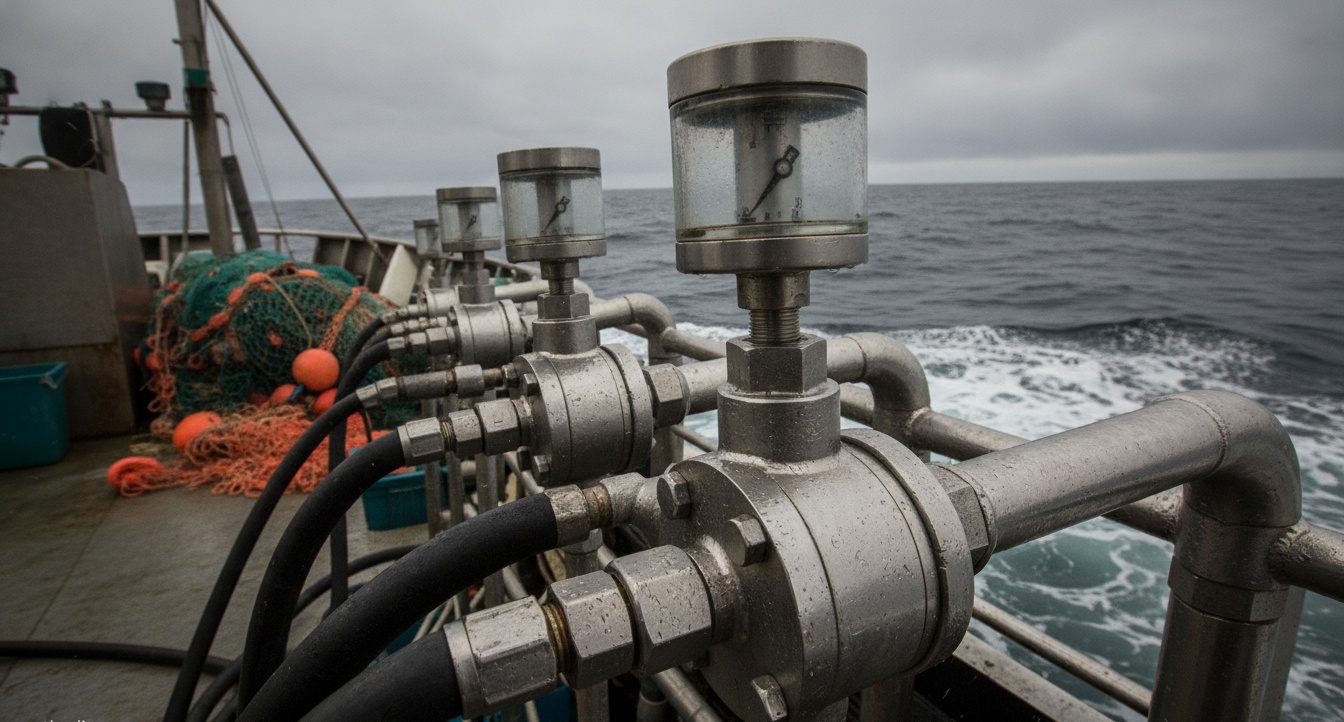
When you’re running a fleet of Norwegian trawlers across the North Sea and Norwegian Sea, every hour of downtime costs money. The hydraulic deck systems that power your anchor winches, trawl winches, and flow dividers are the backbone of your operation — and the flow control valves at the heart of those systems are under constant assault from one of the most corrosive environments on the planet. Saltwater spray. High humidity. Shock loads from heavy catches. The combination is brutal, and choosing the wrong hydraulic flow control valve supplier can mean the difference between a profitable season and a catastrophic breakdown mid-season.
As someone who has spent years working with fishing fleet operators across Scandinavia, I know exactly what you’re looking for: valves that survive saltwater exposure season after season, that match the performance of your existing European components, and that come from a supplier who understands marine applications — not just generic industrial hydraulics. That’s exactly what FLAGUP Hydraulic delivers with our deck-system-grade saltwater-resistant flow control valves, available at MOQ 50 for fleet operators and marine distributors alike.
Why Norwegian Trawlers Face Unique Hydraulic Challenges
Norway’s fishing fleet operates in some of the world’s most demanding maritime conditions. The waters around the Lofoten Islands, the Barents Sea, and the North Sea are notorious for their rough seas, sub-zero temperatures, and constant salt spray. For hydraulic deck systems, this environment creates a set of challenges that simply don’t exist in most industrial applications.
The primary adversary is corrosion. Standard carbon steel hydraulic valve bodies will begin corroding within weeks of exposure to continuous saltwater spray. Internal components — spools, poppets, springs, and seat surfaces — are attacked from both outside and within, as moisture penetrates seal boundaries and condenses inside the valve body during temperature cycles. A valve that looks perfectly functional on the workbench can fail catastrophically after a single season of trawler deployment.
Beyond corrosion, Norwegian trawlers subject their hydraulic systems to extreme mechanical stress. Trawl winches routinely pull loads exceeding 20 tonnes, creating pressure spikes that can exceed 400 bar. Anchor winches experience similar shock loads when setting or retrieving anchors in rough conditions. Gilson winches and deck cranes add additional demands with their constant start-stop cycling. All of this happens while the hydraulic system is continuously exposed to salt water — from deck washdown, from sea spray, and from the humid marine atmosphere that permeates every compartment on an operating vessel.
What this means practically: you need a hydraulic flow control valve supplier who understands that “marine grade” isn’t a marketing term — it’s a material specification, a manufacturing standard, and a quality commitment. At FLAGUP Hydraulic, we’ve engineered our entire deck-system product line specifically for these conditions, drawing on our experience supplying hydraulic cartridge valves to替换 marine applications across Northern Europe.
The Anatomy of a True Saltwater-Resistant Flow Control Valve
Not all valves marketed as “marine grade” are actually built to survive prolonged saltwater exposure. When evaluating a hydraulic flow control valve supplier, you need to understand exactly what separates a genuinely saltwater-resistant valve from one that will corrode and fail within months. Let me walk you through each critical component.
Valve Body Materials
The foundation of any saltwater-resistant hydraulic valve is the body material. For Norwegian trawler applications, we specify 316L stainless steel as the minimum standard, with Duplex stainless steel (UNS S31803) preferred for high-pressure applications exceeding 280 bar. 316L (also designated as EN 1.4404 or ASTM A240) offers excellent corrosion resistance in marine environments due to its low carbon content (maximum 0.03%) and molybdenum addition (2–3%), which provides resistance to pitting and crevice corrosion in chloride-rich seawater.
Duplex stainless steels take this further with their dual-phase microstructure, combining the corrosion resistance of austenitic stainless steel with the strength of ferritic stainless steel. For deck hydraulic applications where weight and space are at a premium, Duplex valves offer the same pressure rating in a smaller, lighter package — a meaningful advantage on a crowded trawler deck.
For seat surfaces and critical sealing areas, we use either Stellite (a cobalt-chromium alloy) or ceramic overlays. Both materials provide exceptional wear resistance and sealing performance even after thousands of operating cycles in seawater environments.
Surface Treatments and Coatings
Raw stainless steel, while corrosion-resistant, is not corrosion-proof. Even 316L stainless steel will show signs of surface corrosion in the harsh salt spray environment of a working trawler deck over time. The solution is to apply additional surface treatments that create a protective barrier on external surfaces.
At FLAGUP Hydraulic, our deck-system valves use a multi-layer coating approach:
- Electroless Nickel Plating (ENP): Applied to external body surfaces, ENP provides uniform coverage including inside bores and recesses where liquid application methods can’t reach. Our standard specification is 25–50 microns of ENP, which provides excellent corrosion resistance while maintaining dimensional tolerances critical for cartridge valve interchangeability.
- Hard Chrome Plating: Applied to internal spool surfaces and other critical moving components, hard chrome provides wear resistance and low-friction operation that extends seal life and maintains precise flow control characteristics over thousands of cycles.
- Marine-Grade Powder Coating: Applied as a final top coat on external surfaces, marine-grade powder coating provides additional UV resistance and color retention for outdoor marine exposure while adding another barrier layer against salt spray penetration.
Seal Materials for Marine Hydraulic Systems
Seals are where most hydraulic valve failures begin in marine environments. Standard NBR (nitrile) seals — common in industrial hydraulic applications — degrade rapidly when exposed to seawater. They become brittle, crack, and lose their sealing properties within weeks of saltwater exposure. For Norwegian trawler applications, only marine-grade seal compounds will deliver acceptable service life.
Our deck-system flow control valves use the following seal specifications:
- EPDM (Ethylene Propylene Diene Monomer): Primary seal material for water-based hydraulic fluids and seawater exposure. EPDM offers excellent resistance to ozone, UV, and saltwater immersion. It maintains flexibility across the full temperature range encountered in Norwegian waters, from sub-zero winter operations to the heat generated during intensive trawling.
- FKM/Viton: Used for shaft seals and dynamic sealing applications where EPDM alone may not provide sufficient chemical resistance. Viton compounds offer excellent resistance to hydraulic fluids, fuels, and the temperature extremes encountered in high-pressure hydraulic systems.
- PTFE Back-up Rings: All dynamic seals use PTFE back-up rings to prevent extrusion and extrusion-related seal failures during high-pressure transients.
Pressure Ratings and Flow Performance for Trawler Applications
Norwegian trawler deck hydraulic systems are not standardized — each vessel class and each application within a vessel has its own pressure and flow requirements. Understanding these requirements is essential when selecting a hydraulic flow control valve supplier, because matching the valve to the system is what determines reliability and longevity.
| Application | Working Pressure | Peak Pressure | Flow Rate | Common Valve Type |
|---|---|---|---|---|
| Anchor Winch | 200–280 bar | 350 bar | 40–120 L/min | Flow control, counterbalance |
| Trawl Winch | 250–320 bar | 400 bar | 150–300 L/min | Flow divider, pressure compensated |
| Gilson Winch | 180–250 bar | 320 bar | 30–80 L/min | Flow control, directional |
| Deck Crane | 200–300 bar | 380 bar | 60–150 L/min | Flow control, priority valves |
| Flow Divider | 250–350 bar | 420 bar | 80–200 L/min | Sequencing, split-flow |
When evaluating a hydraulic flow control valve supplier, ensure their valves carry a minimum working pressure rating of 350 bar — not just 280 bar. The difference matters because Norwegian trawler systems routinely see pressure transients that exceed nominal working pressure by 30–50%. A valve rated at exactly the system’s nominal pressure will be operating at its limit constantly, leading to premature wear and failure. The safety margin matters.
At FLAGUP Hydraulic, our standard deck-system flow control valves are rated at 350 bar working pressure (550 bar burst), with enhanced versions rated at 400 bar working pressure for the most demanding trawl winch applications. Every valve is individually pressure tested to 1.5× working pressure before shipment, with certificates provided as standard.
Corrosion Testing: What You Should Demand From Your Supplier
Claims of “saltwater resistance” are meaningless without third-party verification. When I’m asked by a Norwegian fleet operator what they should demand from their hydraulic flow control valve supplier, I tell them to ask for three specific test reports.
ASTM B117 Salt Spray Testing
The ASTM B117 standard defines the industry-standard salt spray (fog) test for evaluating materials and coatings. Test specimens are placed in a sealed chamber and exposed to a continuous fine mist of 5% sodium chloride solution at 35°C. The standard exposure duration for marine-grade qualification is 1,000 hours — approximately 42 days of continuous exposure.
For a valve to be genuinely qualified as saltwater-resistant, it should pass 1,000 hours of ASTM B117 testing with no significant corrosion, pitting, or coating degradation. Some manufacturers claim “marine grade” with only 200–500 hours of testing — this is not sufficient for the demanding conditions on a Norwegian trawler deck. At FLAGUP Hydraulic, our deck-system valves are tested to 1,500 hours of ASTM B117 exposure as standard, and we have test data available for customer review on request.
Immersion Testing
Salt spray testing evaluates atmospheric corrosion resistance, but trawler deck valves also experience direct saltwater immersion during deck washdown and sea spray events. ASTM D1384 (Standard Test Method for Corrosion Testing of Metals in Simulated Engine Coolant) and custom immersion protocols using actual seawater collected from the North Sea provide data on how valve materials perform during direct saltwater contact. We use both test methods at FLAGUP Hydraulic to fully characterize material performance.
Pressure Impulse Testing
Saltwater corrosion and mechanical pressure loading interact in ways that accelerate failure. When a valve body is under high pressure, stress corrosion cracking can initiate at points of stress concentration — especially in welded areas and around port intersections. Our pressure impulse testing subjects valves to 100,000 cycles at maximum rated pressure with simultaneous saltwater spray exposure, simulating years of real-world trawler deck operation in an accelerated test.
Interchangeability: Replacing European Valves With Confidence
One of the biggest concerns fleet operators have when considering an alternative hydraulic flow control valve supplier is whether the replacement valves will actually fit their existing systems. Parker, Danfoss, Hydroline, and Walther Präzision have been the standard in Norwegian marine hydraulics for decades, and their valve form factors and port configurations are deeply embedded in vessel designs.
At FLAGUP Hydraulic, we specialize in reverse engineering and producing interchangeable alternatives to European hydraulic cartridge valves. Our engineering team has documented the dimensional specifications and performance characteristics of all major European brands, and our deck-system flow control valves are manufactured to match those specifications exactly. Common interchangeability targets include:
- Parker Hannifin: Our NG06 and NG10 cartridge valves match Parker ITC and HC series form factors, including port thread configurations,安装 dimensions, and performance curves.
- Danfoss: Our counterbalance and flow control cartridges match Danfoss PV and PVI series, including the critical spring chamber and adjustment screw specifications.
- Hydroline: Our marine-grade directional and flow control valves match Hydroline’s standard European form factors for direct drop-in replacement.
- Walther Präzision: For high-pressure applications, our WK-series valves match Walther’s flange-mount configurations for compact installation in space-constrained deck machinery.
The practical benefit of this interchangeability is that fleet operators can replace valves during scheduled maintenance without modifying hydraulic piping or manifolds. We provide detailed interchangeability guides with every order, showing dimensional comparisons and performance overlay charts that demonstrate our valves meet or exceed OEM specifications.
“If you’re running a mixed fleet of trawlers — some with older Parker systems, some with newer Hydroline compact manifolds — we can supply all of them from a single product line. That simplifies your inventory, reduces your parts costs, and means you never have to wait for a special order to get back to sea.” — Roger Zhao, Overseas Manager, FLAGUP Hydraulic
What MOQ 50 Means for Your Fleet or Distribution Business
Minimum Order Quantity of 50 units is designed to serve two customer segments: active fishing fleet operators and marine hydraulic component distributors. Let me explain why MOQ 50 makes sense for each.
For Fleet Operators (5–20 Vessel Fleets)
If you’re operating a fleet of 5 to 20 Norwegian trawlers, MOQ 50 means you can stock a comprehensive range of replacement valves — flow control, counterbalance, directional, priority — without tying up excessive capital in inventory. At an average of 8–12 valve positions per trawler hydraulic system, a fleet of 10 vessels has roughly 80–120 valve positions across the fleet. Ordering 50 valves per position gives you coverage for the most common failure points while maintaining a practical buffer stock.
For a typical 10-vessel fleet operating in the North Sea, common valve replacement intervals suggest you might replace 15–25 valves per year across the fleet. Stocking 50 units of each valve type gives you a 2–3 year supply at normal consumption rates, which is practical for inventory management and gives you negotiating leverage on unit pricing.
For Marine Hydraulic Distributors
If you’re a marine hydraulic distributor serving the Scandinavian market, MOQ 50 per valve type allows you to maintain a standardized product line that serves multiple customer segments — from small single-vessel operators to mid-sized fleet owners — without excessive inventory investment. The 50-unit minimum ensures each order achieves the production economics that make competitive pricing possible, while the wide product range means you can serve diverse customer needs from a single supplier relationship.
For international distributors, FLAGUP Hydraulic supports OEM branding arrangements, where valves can be supplied with distributor branding and customized documentation packages tailored to specific market requirements. Contact us to discuss private label arrangements and volume pricing for orders exceeding 500 units.
Quality Assurance and Documentation: The FLAGUP Difference
Every valve we supply to the marine market comes with a comprehensive documentation package. This isn’t optional paperwork — it’s the evidence that allows classification societies and flag state authorities to approve our valves for use on Norwegian-registered vessels. Here’s what you receive with every deck-system flow control valve order:
- Material Test Reports (MTR): Chemical composition and mechanical property certification for every heat of stainless steel used in valve bodies, confirming compliance with 316L or Duplex specifications.
- Pressure Test Certificates: Individual hydrostatic test results for each valve, showing test pressure, test duration, and pass/fail status with actual pressure readings.
- Corrosion Test Reports: Full ASTM B117 salt spray test results with photographic documentation at 250-hour intervals, plus immersion test data using North Sea-simulated seawater.
- Dimensional Inspection Reports: Critical dimensional measurements for every valve, confirming interchangeability with target OEM products.
- Seal Material Certification: Compound identification and temperature/chemical resistance data for all elastomeric seals, confirming EPDM and Viton specifications.
- Batch Traceability: Every valve carries a unique serial number linked to production records, material lot numbers, and test results — enabling precise traceability in the unlikely event of a field failure.
For customers requiring type approval from DNV (Det Norske Veritas), Lloyd’s Register, or Bureau Veritas, we can provide supplementary documentation and work directly with classification society surveyors to facilitate approval processes. Our engineering team has prior experience supporting type approval projects for hydraulic equipment on Norwegian-flagged vessels.
Technical Specifications: FLAGUP Deck-System Flow Control Valves
| Specification | Standard Grade | Enhanced Grade |
|---|---|---|
| Body Material | 316L Stainless Steel | Duplex Stainless Steel (UNS S31803) |
| Working Pressure | 350 bar (5,075 PSI) | 400 bar (5,800 PSI) |
| Burst Pressure | 1,050 bar | 1,200 bar |
| Flow Range | 10–250 L/min | 10–300 L/min |
| Port Configuration | ISO 4401-03 / NG6 | ISO 4401-05 / NG10 |
| Salt Spray Rating | 1,500 hours ASTM B117 | 2,000 hours ASTM B117 |
| Temperature Range | -20°C to +85°C | -30°C to +100°C |
| Seal Material | EPDM + Viton | EPDM + Viton + PTFE backup |
| Coating | ENP + Hard Chrome | ENP + Hard Chrome + Marine Powder |
| Interchangeability | Parker ITC, Danfoss PV | Parker HC, Hydroline, Walther WK |
| MOQ | 50 units | 50 units |
Sourcing From FLAGUP Hydraulic: The Process
Working with FLAGUP Hydraulic as your hydraulic flow control valve supplier is straightforward. Here’s how I personally work with Norwegian fleet operators and marine distributors:
- Initial Consultation: Contact me directly — Roger Zhao, Overseas Manager at FLAGUP Hydraulic. Tell me about your fleet: vessel types, hydraulic system brands currently installed, typical operating conditions, and any specific valve types you need to source or replace. This conversation typically takes 30 minutes and gives me everything I need to provide relevant specifications and pricing.
- Technical Review: I send detailed technical specifications, interchangeability data, and corrosion test reports for the valve types you’re evaluating. For fleet operators, I can provide sample valves for pressure testing and dimensional verification before committing to a full order.
- Pricing and Lead Time: I provide firm pricing for MOQ 50 orders, including unit pricing for larger quantities if you want to stock ahead. Standard lead time for MOQ 50 deck-system valves is 4–6 weeks from order confirmation. Expedited production is available for urgent replacement needs.
- Documentation Package: Every order includes the full documentation package described above — MTRs, pressure test certificates, corrosion test reports, dimensional inspection reports, and batch traceability. If you need type approval support, I coordinate directly with our engineering team to provide supplementary documentation.
- Shipping and Logistics: We ship via DHL, FedEx, or sea freight from our facility in Ningbo, China. For European customers, sea freight typically takes 3–4 weeks. Air freight is available for urgent orders. All shipments are fully insured and include customs documentation for smooth clearance.
Common Mistakes Fleet Operators Make (And How to Avoid Them)
After years of talking with Norwegian fishing fleet operators about their hydraulic system challenges, I’ve seen the same mistakes repeated again and again. Let me save you from making them.
Mistake 1: Buying Industrial-Grade Valves for Marine Applications
The most common error is purchasing standard industrial hydraulic valves — even ones from reputable manufacturers — for trawler deck applications. Industrial valves are designed for controlled factory environments with clean hydraulic fluid and controlled temperatures. They are not designed for salt spray, moisture cycling, and the shock loads of marine deck machinery. The price difference between industrial and marine-grade valves is significant, but so is the failure rate. A $200 industrial valve that fails after 6 months costs far more than a $450 marine-grade valve that runs for 5 years.
Mistake 2: Ignoring Seal Compatibility With Hydraulic Fluid
Many fleet operators don’t realize that seal compatibility varies depending on the hydraulic fluid used in their systems. Standard mineral oil hydraulic systems are compatible with most seal compounds, but some fleet operators use bio-based hydraulic fluids or fire-resistant hydraulic fluids (HF-A, HF-B types) that are chemically aggressive to certain seal materials. Always verify seal compatibility with your specific hydraulic fluid before ordering replacement valves.
Mistake 3: Not Maintaining a Critical Spare Parts Inventory
Norwegian trawler operations cannot afford extended downtime waiting for parts to arrive from overseas. The geography of Norway — with its long coastline and often limited access to specialized hydraulic workshops — means that having the right spares on board can mean the difference between completing a fishing trip and returning early with a damaged catch. Stocking MOQ 50 of your critical valve types means you have replacement inventory on hand when failures occur, rather than losing days or weeks of fishing time waiting for international shipping.
Mistake 4: Choosing Suppliers Based on Price Alone
I’ve seen fleet operators make purchasing decisions based almost entirely on unit price, only to discover that the “bargain” valves they received had no documentation, inconsistent dimensional tolerances, and wildly inconsistent pressure performance across the batch. The true cost of a hydraulic valve isn’t the purchase price — it’s the cost of failure, which includes not just replacement parts, but hydraulic fluid losses, labor for diagnosis and replacement, and lost catch revenue during downtime. A reputable hydraulic flow control valve supplier with full documentation and consistent quality will always deliver lower total cost of ownership than the cheapest alternative.
Why FLAGUP Hydraulic Is the Right Partner for Norwegian Trawler Operations
I’ve been the Overseas Manager at FLAGUP Hydraulic for over eight years, and in that time I’ve supplied hydraulic components to fleet operators and distributors across Scandinavia, Northern Europe, and globally. What I can tell you is this: we built our deck-system product line specifically for operators like you — people who run vessels in some of the most demanding marine environments on Earth and who cannot afford unexpected hydraulic failures.
Our approach is different from generic hydraulic valve manufacturers. We focus exclusively on high-end hydraulic cartridge valves — the kind that replace imported equivalents from Parker, Danfoss, Hydroline, and Walther. We don’t try to be everything to everyone. We do one thing very well: we manufacture hydraulic cartridge valves that match or exceed OEM specifications, with the materials, coatings, and documentation that marine applications demand.
Our Ningbo facility operates under lean manufacturing principles, which means we can produce MOQ 50 orders at pricing that competes favorably with high-volume Asian manufacturers while maintaining the quality standards that Norwegian fleet operators require. Every valve we produce is manufactured to the same specifications whether you’re ordering 50 units or 500 units — we don’t operate different quality tiers for different order sizes.
For me personally, this isn’t just a business relationship. I work closely with our customers throughout the ordering and delivery process, and I take responsibility for ensuring that the valves I supply are exactly what you need. If a valve doesn’t fit, if the documentation is incomplete, if the pressure rating doesn’t match your system — I want to know about it, and I want to fix it. That’s why I maintain direct communication with every customer throughout the lifecycle of the product.
Conclusion: Making the Right Choice for Your Hydraulic Systems
Norwegian trawler deck hydraulic systems operate in an environment that punishes substandard components. Saltwater, shock loads, high pressure, and temperature extremes combine to create conditions where only genuinely marine-grade hydraulic flow control valves will perform reliably. The stakes are real: a failed valve mid-season means lost catch, expensive emergency repairs, and potential safety risks for your crew.
When you’re evaluating a hydraulic flow control valve supplier, look beyond the price sheet. Ask for material test reports, corrosion test data, pressure test certificates, and interchangeability documentation. A supplier who can provide all of these — and who has experience supplying marine applications in Scandinavia — is worth working with. A supplier who can’t provide these documents is telling you something important about their product quality.
At FLAGUP Hydraulic, we’re proud to supply deck-system-grade saltwater-resistant hydraulic flow control valves to Norwegian fleet operators and marine distributors worldwide. Our MOQ 50 structure is designed to make high-quality marine hydraulics accessible whether you’re operating a single vessel or managing a multi-vessel fleet. Contact me — Roger Zhao — to discuss your specific requirements, and I’ll personally ensure you receive the right specifications, pricing, and documentation for your application.
Need Saltwater-Resistant Hydraulic Flow Control Valves for Your Fleet?
Contact Roger Zhao at FLAGUP Hydraulic for technical specifications, MOQ 50 pricing, and full documentation packages for deck-system-grade saltwater-resistant flow control valves.