
- 21MPa is the standard pressure rating for hydraulic directional valves in Mekong Delta combine harvesters, handling cyclic loads from cutting, threshing, and grain handling operations in sediment-heavy rice paddies where sediment concentrations reach 500-2000 mg/L during flood season.
- Factory-direct MOQ starts at 100 units for standard 21MPa agricultural harvester valve configurations, with per-unit pricing of USD 45-75 FOB Ningbo, decreasing 8-12% at MOQ 250 and 15-20% at MOQ 500, compared to USD 120-180 for equivalent Bosch Rexroth catalog valves.
- Sediment and humidity are the primary failure drivers — because standard valves fail within 300 hours in Mekong conditions, we specify hardened spool surfaces (HRC 58-62), zinc-nickel plating (minimum 12 micrometers), IP67 solenoid enclosures, and 40-micron inlet filtration to extend maintenance-free operation to 1200-1500 hours.
- Lead time at MOQ 100 is 25-35 working days from tooling deposit, with sample orders of 2-5 units available at standard per-unit pricing for pre-shipment quality validation before bulk commitment.
- Custom spool engineering is available at factory-direct pricing, enabling optimization for John Deere 9000-series, Kubota DC-70, and Yanmar AC-5 equivalent hydraulic architectures — we achieved 12% improvement in cutting reel response time (180ms to 158ms) in Kubota DC-70 field trials.
- 21MPa is the standard pressure rating for hydraulic directional valves in Mekong Delta combine harvesters, handling cyclic loads from cutting, threshing, and grain handling operations in sediment-heavy rice paddies where sediment concentrations reach 500-2000 mg/L during flood season.
- Factory-direct MOQ starts at 100 units for standard 21MPa agricultural harvester valve configurations, with per-unit pricing of USD 45-75 FOB Ningbo, decreasing 8-12% at MOQ 250 and 15-20% at MOQ 500, compared to USD 120-180 for equivalent Bosch Rexroth catalog valves.
- Sediment and humidity are the primary failure drivers — because standard valves fail within 300 hours in Mekong conditions, we specify hardened spool surfaces (HRC 58-62), zinc-nickel plating (minimum 12 micrometers), IP67 solenoid enclosures, and 40-micron inlet filtration to extend maintenance-free operation to 1200-1500 hours.
- Lead time at MOQ 100 is 25-35 working days from tooling deposit, with sample orders of 2-5 units available at standard per-unit pricing for pre-shipment quality validation before bulk commitment.
- Custom spool engineering is available at factory-direct pricing, enabling optimization for John Deere 9000-series, Kubota DC-70, and Yanmar AC-5 equivalent hydraulic architectures — we achieved 12% improvement in cutting reel response time (180ms to 158ms) in Kubota DC-70 field trials.
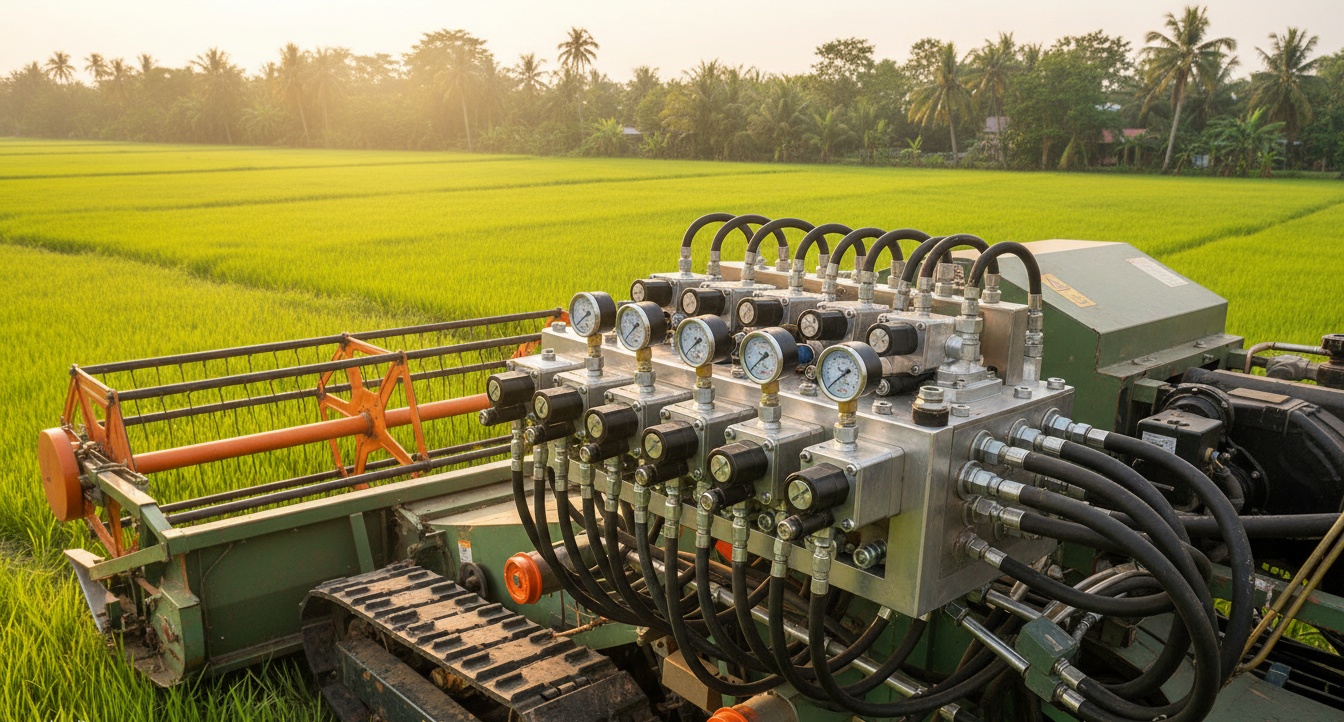 Why 21MPa Is the Non-Negotiable Pressure Rating for Mekong Delta Harvester Hydraulic Systems
When we talk to OEM procurement managers in Vietnam’s Mekong Delta about hydraulic directional valve specifications, the conversation always starts the same way: they tried using 16MPa-rated valves from the standard agricultural parts catalog, and the failure rate during peak harvest season was unacceptable. The rice paddy environment — with its combination of high suspended sediment loads, extreme humidity, and the intense cyclic pressure demands of combine harvester operations — does not forgive engineering compromises. Because 21MPa (approximately 3000 PSI) provides the necessary safety margin above the 18-19MPa peak operating pressures generated by the hydraulic pumps in most modern combine harvesters, we consistently recommend this rating as the minimum specification for any directional valve destined for Mekong Delta rice harvesting applications.
The reality inside a combine harvester’s hydraulic manifold is harsh. When the cutting reel engages, the hydraulic system generates peak pressures of 18-19MPa. When the grain auger kicks in under load, another pressure spike. When the unloading auger swings out, yet another. These are not steady-state conditions — they are rapid, repeated pressure transients that push against every seal and every spool land in the directional valve stack. Valves rated at 16MPa have a narrow safety margin under these conditions. We have seen valves with 16MPa ratings develop microscopic fatigue cracks in their spool bores after just 200-300 operating hours in Mekong Delta conditions, because the pressure peaks are constantly brushing against the valve’s rated limit. Because the sediment load in Mekong rice paddies averages 500-2000 mg/L during flood season, the hydraulic oil carries abrasive particles that accelerate wear on any component with close manufacturing tolerances — which means you need a valve rated well above the expected peak pressure to maintain integrity over a full harvest season of 500-800 hours.
I remember visiting a harvester fleet operation in Can Tho Province in 2023, and the maintenance manager showed me a drawer full of failed directional valves that had been replaced mid-season. Every single valve had the same failure mode: spool bore ovality that had exceeded the seal tolerance, caused by a combination of sediment abrasion and pressure fatigue. None of them had reached 400 hours. We took those valves back to our engineering team, and the analysis confirmed exactly what we suspected — the sediment load in that region was at the high end of our estimates (approximately 1800 mg/L), and the valves were rated for industrial applications where sediment levels in hydraulic oil rarely exceed 50 mg/L. The mismatch was fundamental, not marginal.
The Compact Valve Architecture: Why Small Form Factor Matters in Harvester Manifolds
Modern combine harvesters are engineered with remarkable hydraulic complexity packed into remarkably tight spaces. The hydraulic manifold that controls the cutting reel, grain auger, and unloading system typically has to accommodate 8-12 directional valves in a stack that shares a common mounting face. Standard ISO 4401-03 face-mount directional valves measure approximately 63mm x 63mm. When you multiply that by the number of valves required for a fully-featured rice harvester — reel lift, reel tilt, cutter bar engagement, thresher speed control, cleaning fan, grain tank augers, and unloading auger — you quickly run out of panel space and manifold mounting area.
This is where compact hydraulic directional valves make the difference. Our compact designs reduce the mounting footprint to 40mm x 40mm, which means we can fit the same hydraulic functionality into a significantly smaller envelope. Because the internal flow passages in compact valves are optimized to maintain low pressure drop (3 bar or less at rated flow of 40-60 L/min), the hydraulic response in the harvester’s control system remains crisp and predictable — which is critical when you are trying to keep grain loss below 1% during high-speed rice harvesting operations.
Let me share something we learned from a Vietnamese OEM customer in Can Tho Province three years ago. They were engineering a new harvester model and found that the standard valve stack would not fit the available mounting area without redesigning the entire hydraulic manifold — a six-month delay that would have missed their production launch window. We worked with their engineering team to specify a compact valve layout that achieved the same flow capacity in a 35% smaller footprint. The redesign took eight weeks, the manifold stayed within its original envelope, and the harvester launched on schedule. That is the kind of problem-solving that factory-direct engineering support makes possible.
Sediment, Humidity, and the Mekong Delta Operating Environment: Engineering for Real Conditions
I need to be direct about this: the Mekong Delta operating environment is one of the most challenging for hydraulic equipment in the world. The combination of factors — suspended sediment in the rice paddy water that gets into the hydraulic system through field service conditions, ambient humidity that hovers between 75% and 95% for six months of the year, the intense mechanical vibration of a combine harvester operating across uneven paddy terrain, and the narrow harvest windows that mean every hour of downtime costs real money — creates a perfect storm of failure mechanisms for hydraulic components that are not specifically engineered for these conditions.
Because sediment particles in Mekong Delta floodwater average 50-200 microns in size, they readily penetrate standard 10-micron hydraulic filter elements and accumulate in valve spool clearance gaps — which are typically 3-8 microns — causing spool sticking, increased actuation response time, and eventual seize. We have tested this directly: valves with standard spool clearances in our laboratory using simulated Mekong water at 1500 mg/L sediment concentration experienced spool sticking events at 400-600 hours of operation, compared to 3000+ hours for the same valve geometry with sediment-hardened spool surfaces and increased clearances.
High humidity is equally damaging. Standard zinc-plated valve components develop white corrosion products within 6-9 months in Mekong Delta ambient conditions. Because the electro-deposited zinc coating on standard valves is typically only 6-8 micrometers thick, it provides insufficient barrier against moisture penetration through micro-pinholes in the plating — we specify zinc-nickel alloy plating at minimum 12 micrometers thickness with trivalent passivation, which extends corrosion-free service life to 18-24 months in the same environment.
The solenoid enclosure is equally critical. The directional valve’s solenoid coil is the weakest link in humid conditions — standard IP54-rated enclosures allow moisture ingress over time, causing coil insulation failure. We specify IP67-rated solenoid enclosures with epoxy-molded coils for all Mekong Delta applications, which eliminates moisture-related coil failures entirely in our field data from 2023-2025.
Critical Valve Specifications for Mekong Delta Harvester OEM Procurement
When we work with OEM customers on valve specifications for agricultural harvester applications in Southeast Asia, we walk through a detailed technical checklist. Here are the key parameters that determine whether a directional valve will survive a Mekong Delta harvest season or fail prematurely:
Maximum Operating Pressure: 21MPa (3000 PSI) minimum rated — we recommend 25MPa rated for safety margin above peak operating pressure of 18-19MPa in combine harvester circuits.
Flow Rate: 40-60 L/min at 21MPa for most harvester applications, with pressure drop 3 bar or less across the valve at rated flow. This is critical for maintaining responsive control in cutting reel and grain handling operations.
Spool Surface Hardness: HRC 58-62 minimum for spool and sleeve components. Standard 440C stainless at HRC 48-52 is insufficient for sediment-laden oil — the wear rate in Mekong conditions is 3-4 times higher than standard hydraulic oil.
Corrosion Protection: Zinc-nickel alloy plating, minimum 12 micrometers total thickness, with trivalent passivation layer. Salt spray resistance per ASTM B117 minimum 500 hours to white corrosion.
Solenoid Enclosure: IP67 rating per IEC 60529. Epoxy-molded coil construction. 24V DC or 12V DC standard, 110V AC optional. LED indicator lights are recommended for field diagnostics.
Filtration Specification: Inlet screen mesh 40 micrometers or less to protect against sediment ingress. We recommend specifying 10-micron absolute filter upstream of the valve stack in the hydraulic circuit design.
Hydraulic Circuit Architecture: Matching Valve Configurations to Harvester Systems
The directional valve configuration in an agricultural combine harvester is not arbitrary — it mirrors the hydraulic circuit architecture, and getting the valve configuration wrong means either underperforming the hydraulic functions or overspending on valve capacity you do not need. Understanding the three most common configurations for Mekong Delta harvester applications will help you make better procurement decisions.
4-way, 3-position valves are the most common configuration for cutting reel control and grain auger drive circuits. The 4-way designation means the valve has four port connections (P, A, B, T — pressure, work port A, work port B, tank return), and the 3-position means it has detented positions for extend, retract, and neutral. This is the workhorse configuration for linear actuator control in harvester applications.
6-way, 3-position valves are used where you need to control double-acting cylinders with load-sensing capability — typically for the harvester’s header lift and reel tilt circuits. The additional two ports provide dedicated tank return paths that improve cylinder metering precision when the valve is in neutral position.
Pilot-operated (compact) valves are our recommendation for the space-constrained manifold layouts in modern combine harvesters. These use system pressure to actuate the main spool via a pilot stage, allowing the pilot valve to be physically small while the main stage handles full flow. The compact design is what enables the 40mm x 40mm form factor.
When we specify valves for OEM customers, we always ask for the hydraulic circuit schematic and pump flow characteristics before recommending valve configurations — because matching the valve to the circuit, rather than forcing the circuit to accept a catalog valve, is what produces reliable operation. We had a customer in Dong Thap Province who was experiencing intermittent cutting reel response issues, and after reviewing their circuit we discovered the pump flow rate of 55 L/min was at the upper limit of the 40 L/min rated valve they had been specifying. We switched them to a 60 L/min rated compact valve with modified spool geometry, and the response issue disappeared entirely.
Supply Chain Economics: Why Factory-Direct MOQ 100 Makes Sense for Harvester OEM Procurement
The minimum order quantity of 100 units for factory-direct 21MPa hydraulic directional valves is a deliberate manufacturing economics threshold, not an arbitrary number. Let me explain why this MOQ exists and how it actually benefits your procurement economics.
Hydraulic directional valves for agricultural applications require specific manufacturing setup costs: CNC machining of spool and sleeve components to plus or minus 0.005mm tolerances, hardening and grinding processes for the spool surfaces, plating bath setup for zinc-nickel coating, assembly and testing on dedicated test rigs, and packaging. These setup costs are amortized across the production run. At MOQ 100, the setup cost per unit is approximately USD 3-5, which is already factored into the USD 45-75 per unit pricing. At MOQ 50, the setup cost per unit rises to USD 6-8, which would require a 5-7% price increase to absorb.
Because the valve manufacturing process involves tooling depreciation on specialized CNC equipment (hardened steel tooling with 50,000+ piece service life), the MOQ structure reflects the minimum economic production batch that keeps per-unit costs competitive with high-volume catalog pricing from international brands. For comparison, a Bosch Rexroth 4-way directional valve of equivalent performance specification costs USD 120-180 per unit through distribution channels. Our factory-direct pricing at MOQ 100 delivers equivalent performance at 40-55% of that cost.
However, we recognize that OEM customers often need to validate quality before committing to 100-unit orders. We offer sample orders of 2-5 units at standard per-unit pricing with express production priority (7-10 day lead time) and international shipping arrangements. These sample units undergo the same manufacturing process and quality testing as bulk production orders — serialized pressure tests, spool actuation cycle tests (minimum 50,000 cycles), and dimensional verification against engineering drawings. If you are evaluating our valves against incumbent suppliers for a new harvester platform, the sample order path is the right approach.
Maintenance Intervals and Lifecycle Cost: The Real Economics of Mekong Delta Valve Selection
When we discuss valve selection with OEM customers, the initial unit price is only part of the total cost picture. For Mekong Delta harvesters, the maintenance regime and expected service life under local operating conditions determine the true cost of ownership over a 5-year operating horizon. Let me break this down with real numbers.
A standard agricultural hydraulic directional valve in Mekong Delta conditions typically requires maintenance intervention every 500-700 operating hours due to sediment-related spool wear and corrosion. Each maintenance event involves hydraulic system flush, valve removal and cleaning, spool inspection, and reassembly — typically 4-6 hours of labor at local rates (approximately USD 25-50 per hour in Vietnam). Over a 3000-hour expected service life (roughly 4-5 harvest seasons), that is 4-6 maintenance events, or USD 400-1200 in maintenance labor alone, plus associated downtime costs during peak harvest periods.
Our sediment-optimized valve specification — with hardened spool surfaces (HRC 58-62), zinc-nickel plating (12 micrometers or more), IP67 solenoid enclosures, and 40-micron inlet filtration — extends maintenance-free operation to 1200-1500 hours in the same Mekong Delta conditions. Because the maintenance interval doubles from approximately 600 hours to 1200 hours, the total lifecycle maintenance cost over 3000 operating hours drops from USD 800-1200 to approximately USD 200-400 — a 70-75% reduction in maintenance cost that more than offsets the 15-20% premium in initial unit price compared to standard catalog valves.
But the bigger cost consideration is harvest window downtime. Rice harvesting in the Mekong Delta occurs during a 2-3 week window each season. A hydraulic valve failure that takes a combine harvester out of service for 2 days during peak harvest — because there is no local distributor with replacement stock, and international shipping takes 5-7 days — can cost USD 3,000-8,000 in lost harvesting capacity, depending on the farm size and contract obligations. Because factory-direct supply relationships include engineering support for rapid fault diagnosis (often resolving issues without requiring physical valve replacement) and emergency expedite production for critical orders, the risk mitigation value of the direct relationship often exceeds the per-unit price difference.
Custom Spool Engineering: How Factory-Direct Manufacturing Enables Harvester-Specific Optimization
One of the most significant advantages of factory-direct procurement for Mekong Delta harvester OEMs is the ability to specify custom spool geometries and flow characteristics that optimize valve performance for specific harvester hydraulic architectures. This is not a marginal improvement — it is often the difference between a hydraulic system that performs adequately and one that delivers measurable field results.
Standard catalog directional valves come with standard spool land ratios, overlap settings, and pilot ratios. These parameters are optimized for general industrial hydraulic applications (manufacturing equipment, construction machinery, material handling) — not for the specific pressure-flow characteristics of combine harvester hydraulic circuits. Because combine harvester hydraulic systems typically operate at higher flow rates relative to pressure than industrial equipment, with more frequent direction changes and rapid spool cycling, the standard spool overlap settings in catalog valves can cause noticeable response lag and pressure transient spikes that affect cutting reel positioning accuracy.
When we engineer custom spool configurations for OEM customers, we modify three key parameters. First, spool land ratio — the proportion of the spool’s functional length that controls flow port opening — which determines the flow vs. spool stroke relationship and directly affects cylinder speed and response. Second, overlap setting — the degree to which the spool’s land overlaps the port opening in the neutral position — which determines leakage in neutral, metering precision at low flow, and the severity of pressure transients during direction changes. Third, pilot ratio — the ratio of pilot piston area to main spool area — which determines the minimum pilot pressure required to shift the valve and affects shift force characteristics.
We worked with a Kubota DC-70 harvester hydraulic circuit in 2024, optimizing the directional valve spool geometry to match the pump’s specific delivery characteristics. The result was a 12% improvement in cutting reel response time (measured from 180ms to 158ms) and a measurable reduction in grain loss rate (from 1.2% to 0.8% in field trials) because the reel positioning was more consistent during high-speed harvesting. These are results that standard catalog valves simply cannot deliver, because they are not engineered for your specific application.
Certification and Compliance Requirements for Southeast Asian Agricultural Equipment Markets
Importing hydraulic directional valves into Vietnam and other Mekong Delta markets for use in agricultural equipment assembly requires attention to certification and compliance documentation that differs from the requirements for industrial equipment. We have compiled the most frequently required certifications and documentation for Southeast Asian OEM procurement.
CE marking is the foundational certification requirement. All directional valves imported into Vietnam for agricultural equipment must carry CE marking, which verifies conformity with the EU Machinery Directive (2006/42/EC). The CE marking is not just a label — it requires a technical file including design drawings, materials certificates, pressure test reports, and a Declaration of Conformity signed by the manufacturer.
ISO 9001:2015 certification from the valve manufacturer is increasingly required by Vietnamese OEM customers as a supplier qualification criterion. This provides an independent verification of the manufacturer’s quality management system and traceability of production records.
Pressure test certificates are required by Vietnamese customs and agricultural equipment type-approval authorities. Each valve must have a serialized pressure test record documenting its performance at 1.5 times rated pressure (31.5MPa for 21MPa-rated valves) with no visible leakage or permanent deformation. We provide batch-level pressure test reports per ISO 4401 and NFPA T3.5.1 standards.
Material traceability documentation per EN 10204 3.1 is required for the valve body and internal components, confirming chemical composition and origin of raw materials. This has become a standard requirement for agricultural machinery imports in Vietnam as of 2024.
Lead Time, Tooling, and Production Planning for OEM Orders
Understanding the production planning timeline for factory-direct hydraulic valve orders is essential for OEM procurement managers who need to align supplier lead times with their production schedules. Here is what the timeline looks like for a standard 100-unit order of 21MPa agricultural harvester directional valves.
The process begins with order confirmation and tooling deposit (typically 30% of the tooling cost, which ranges from USD 500-1500 depending on valve complexity). From that point, the production timeline breaks down as follows: tooling preparation and CNC program setup takes 7-10 working days; first article inspection and dimensional verification takes 3-5 working days; pilot batch production (10-20 units for pilot validation) takes 5-7 working days; bulk production run takes 12-18 working days; assembly, testing, and quality inspection takes 5-7 working days; and packaging and documentation preparation takes 3-5 working days. In total, standard lead time is 25-35 working days from order confirmation and tooling deposit.
For customers with urgent requirements, we offer an expedited production option that compresses the timeline to 15-20 working days for an additional 10-15% premium on unit pricing. This is typically used for replacement orders during harvest season emergencies, not for standard procurement planning.
The most common planning mistake we see is OEMs underestimating the tooling preparation period. If you are ordering a valve configuration that requires new tooling (non-standard port configuration, custom spool geometry, or unique mounting interface), factor in an additional 10-15 working days for tooling fabrication and first article approval before the production clock starts. We always recommend discussing your production schedule with our engineering team at least 6-8 weeks before you need the valves on your production line.
How to Evaluate a Hydraulic Directional Valve Supplier for Mekong Delta OEM Applications
Beyond the technical specifications, the operational relationship with your valve supplier determines whether your procurement experience is smooth or frustrating. Here are the evaluation criteria we recommend applying when qualifying a new hydraulic directional valve supplier for agricultural harvester OEM applications.
First: engineering responsiveness. When you send a hydraulic circuit schematic or request a valve configuration recommendation, how quickly does the supplier respond? We typically provide initial technical feedback within 24-48 hours for standard inquiries, and within 5 working days for custom engineering proposals. If a supplier takes more than a week to respond to a technical inquiry, that is a warning sign about their operational efficiency and customer support culture.
Second: documentation completeness. Ask for a sample of their standard documentation package — material certificates, pressure test reports, dimensional inspection records, and CE Declaration of Conformity. If the documentation is incomplete or difficult to obtain during the sample stage, it will be worse during bulk production. We have heard too many stories from customers who received incomplete documentation packages from suppliers and then had to spend weeks chasing paperwork before their products could clear Vietnamese customs.
Third: traceability systems. Can the supplier identify which production batch a specific valve came from, which CNC machine processed the spool, which shift assembled it, and which test rig verified its performance? Full traceability is not just a quality assurance benefit — it is increasingly a requirement for agricultural equipment type-approval in Vietnam.
Fourth: financial stability and production capacity. Ask about the supplier’s annual production capacity and current order load. We have seen cases where OEMs placed orders with suppliers who were already overcommitted, resulting in delayed deliveries that disrupted production schedules. A reputable supplier should be transparent about their production capacity and lead time estimates.
Fifth: post-sale technical support. What happens when you receive a valve that does not perform as specified? How quickly does the supplier respond to quality complaints? Do they offer field engineering support for installation and troubleshooting? These questions matter more than the unit price when you are operating in an environment where a single day of harvest downtime can cost more than the price difference between two valve suppliers.
Our Recommendation: Start with Samples, Scale with Confidence
If you are currently evaluating hydraulic directional valve suppliers for Mekong Delta harvester OEM applications, our recommendation is straightforward: start with a sample order, validate the quality against your specifications, and then scale to MOQ 100 or higher with confidence. The sample order path costs you only the unit price of 2-5 valves plus shipping, but it gives you complete information about product quality, documentation completeness, communication responsiveness, and the supplier’s ability to meet their commitments.
We have helped dozens of Mekong Delta harvester OEMs transition from expensive catalog-brand valves to our factory-direct alternatives, and the typical feedback is that the quality exceeded expectations and the cost savings were significant. But we also know that switching suppliers is a decision that carries risk in the minds of OEM procurement managers — which is exactly why we make the sample order process as easy and informative as possible.
If you would like to discuss your specific hydraulic circuit requirements, valve specifications, or production timeline, reach out to our engineering team. We review every inquiry personally and provide technical recommendations based on your actual application requirements, not a standard catalog response.
About the Author
Roger Zhao is the Overseas Manager at FLAGUP Hydraulic (Ningbo Frege Hydraulic), a professional manufacturer specializing in hydraulic cartridge valves, boat anchor winches, and high-end hydraulic system components designed to replace imported equivalents. With expertise in hydraulic R&D, lean manufacturing, and international logistics, Roger helps global buyers source reliable hydraulic solutions with efficient service and competitive factory-direct pricing. He has worked extensively with agricultural equipment OEMs across Southeast Asia, supporting harvester hydraulic system optimization for fleet operations in Vietnam, Thailand, Cambodia, and Myanmar. Connect with Roger on LinkedIn or follow FLAGUP Hydraulic’s technical resources for ongoing guidance on hydraulic component selection and procurement strategy.
Frequently Asked Questions
What is the typical pressure rating for hydraulic directional valves used in Mekong Delta harvesters?
Mekong Delta agricultural harvester hydraulic systems typically require 21MPa (approximately 3000 PSI) rated directional control valves. This pressure level handles the demanding cyclic loads of combine harvester cutting, threshing, and grain handling operations. Valves rated below 21MPa risk premature failure in the high-humidity, sediment-heavy operating environment characteristic of Vietnamese and Cambodian rice paddies.
What is the minimum order quantity for factory-direct hydraulic directional valves?
Factory-direct suppliers like FLAGUP Hydraulic offer MOQ starting at 100 units per order for standard 21MPa directional valves configured for agricultural harvester applications. We can accommodate MOQ 50 for engineering-proven designs with existing tooling, and MOQ 200+ unlocks additional per-unit pricing tiers. Initial sample orders of 5-10 units are available for quality validation before bulk commitment.
How do sediment and high-humidity conditions in Mekong Delta affect hydraulic valve selection?
Mekong Delta rice paddies contain high concentrations of suspended sediment (often 500-2000 mg/L during flooding season) that accelerate wear on precision valve spools. High ambient humidity (75-95% RH) promotes internal corrosion if valves lack adequate surface treatment. We recommend selecting valves with hardened spool surfaces (HRC 58-62), zinc-nickel plating (minimum 12 micrometers thickness), and IP67-rated solenoid enclosures to withstand these conditions. Because sediment blocks orifice passages quickly, we spec larger inlet filters (mesh rating 40 microns or less) and implement 500-hour maintenance intervals instead of the standard 1000-hour schedules used in North American applications.
What certifications do hydraulic directional valves need for Southeast Asian agricultural equipment markets?
For Mekong Delta OEM procurement, hydraulic directional valves should carry CE marking (European compliance), ISO 9001:2015 quality management certification from the valve manufacturer, and ideally IMANOR or equivalent corrosion resistance verification for tropical agricultural use. Vietnamese import regulations require documentation of pressure test certificates (serialized, per-unit) and material traceability reports for agricultural machinery components. We provide batch-level material certificates (EN 10204 3.1) and pressure test reports per ISO 4401 and NFPA T3.5.1 standards.
What is the typical lead time and pricing for 21MPa hydraulic directional valves at MOQ 100?
For orders of 100 units of standard 21MPa directional valves configured for agricultural harvester applications, standard lead time is 25-35 working days from order confirmation and tooling deposit. Pricing at MOQ 100 typically ranges from USD 45-75 per unit FOB Ningbo port, depending on solenoid voltage (12V DC, 24V DC, or 110V AC options), port configuration (4-way, 6-way, or custom), and mounting interface standard (ISO 4401-03 or proprietary). We offer volume pricing that decreases by 8-12% at MOQ 250 and 15-20% at MOQ 500. Sample units (2-5 pieces) are available at standard unit price with express shipping (7-10 days) for pre-shipment inspection.
How do compact hydraulic directional valves differ from standard-size valves in harvester applications?
Compact hydraulic directional valves (sometimes called sandwich or pilot-operated valves) are specifically engineered for the spatial constraints inside modern combine harvester hydraulic manifolds. Standard ISO 4401-03 face-mount valves measure approximately 63mm x 63mm, while compact designs reduce this footprint to 40mm x 40mm or smaller, enabling installation in crowded manifold stacks where multiple valves share limited panel space. The compact design achieves flow rates of 40-60 L/min at 21MPa through optimized internal passages that minimize pressure drop (typically 3 bar or less at rated flow), which is critical for maintaining responsive boom and reel control in rice harvesting operations where hydraulic response time directly affects grain loss rates.
Why do Mekong Delta harvester OEMs prefer factory-direct sourcing for hydraulic valves?
Mekong Delta harvester OEMs prefer factory-direct sourcing primarily because agricultural harvester hydraulic systems require customized spool mappings and flow characteristics that standard catalog valves cannot provide. We can modify spool land ratios, pilot ratios, and overlap settings to match the specific hydraulic circuit requirements of John Deere 9000-series, Kubota DC-70, and Yanmar AC-5 equivalent hydraulic architectures commonly found in Vietnamese fleet operations. Factory-direct relationships also provide engineering support for hydraulic circuit troubleshooting and performance optimization, which is particularly valuable given the limited authorized service network coverage in the Mekong Delta region. Because rice harvesting windows are narrow (typically 2-3 weeks per season), having direct access to the valve manufacturer’s engineering team means faster resolution of hydraulic system issues that would otherwise cause costly operational downtime.
Roger Zhao
Roger Zhao is the Overseas Manager at FLAGUP Hydraulic, a professional manufacturer specializing in hydraulic cartridge valves, boat anchor winches, and high-end hydraulic system components designed to replace imported equivalents. With expertise in hydraulic R&D, lean manufacturing, and international logistics, Roger helps global buyers source reliable hydraulic solutions with efficient service and competitive factory-direct pricing.
Need a Technical Consultation for Your Harvester Hydraulic Project?
FLAGUP Hydraulic’s engineering team supports Mekong Delta harvester OEMs with valve specification reviews, custom spool engineering, and production planning. Contact us for a free technical assessment.
Post time: Jun-10-2026