
TL;DR
For OEM sourcing, choose a hydraulic solenoid valve manufacturer in China that can match the complete valve function, mechanical interface and electrical operating conditions, then demonstrate that match with relevant test evidence. A familiar-looking cartridge or a higher headline pressure rating is insufficient.
My first technical question would be: what must remain unchanged in the machine? Sometimes the manifold is fixed. Sometimes the controller is fixed. Sometimes an OEM can redesign both. That answer determines whether the supplier should offer an existing valve, an adapted configuration or a new integrated solution.
Know which sourcing job you are buying
A replacement inquiry, a drawing-based order and a new manifold project need different engineering commitments. Calling all of them “OEM customization” obscures who owns the design work and who must validate the result.
For an existing manifold, start with its controlled cavity drawing, circuit diagram and installed valve specification. A cavity is the machined bore, steps and sealing interfaces that receive a screw-in cartridge. A replacement must satisfy these interfaces as well as the circuit function.
For a drawing-based order, identify which details the buyer controls and which the manufacturer may develop. A supplier should not change a seal compound or coil configuration merely because the external dimensions remain unchanged.
For a new manifold, the manufacturer may have room to select the cartridge and optimize passages together. That flexibility can solve packaging or pressure-drop problems, but it also expands the validation scope. Treat it as an assembly development project rather than purchasing an isolated valve.
Flag-up’s hydraulic solenoid valve range includes two-way normally closed valves, three-way spool valves and a two-position four-way valve. This is a useful starting point for identifying a function family; it is not a list of interchangeable parts.
Read “normally closed” as a question about specific ports
A normally closed designation must be read with the flow direction and energized-state behavior. De-energized means the coil is not powered. It does not necessarily mean that every possible flow path through the valve is blocked.
Flag-up’s 22DH-A08 product description states that, without power, flow is allowed from port 1 to port 2 while port 2 to port 1 is blocked. When energized, it opens port 2 to port 1 and describes the opposite direction as severely restricted.
The 22DH-A10 poppet valve description gives the same de-energized check-valve direction, but states that flow from port 1 to port 2 is also allowed when energized. A poppet is a moving element that closes against a seat. These published operating descriptions make the reverse-flow question material to selection; the approved symbol and configuration must resolve the intended behavior.
If the proposed replacement permits a flow path the original circuit relies on blocking, it can change actuator behavior even when the cartridge fits perfectly. Map each relevant path with power on and off, including return flow and backpressure conditions. Backpressure is pressure acting on the downstream or return side of the valve.
There are also normally closed designs intended to block both directions without power. For example, HydraForce describes its SV08-24 as a bidirectional blocking spool valve in the de-energized state. This illustrates why the label alone is incomplete; it is not a cross-reference approval for a Flag-up model.
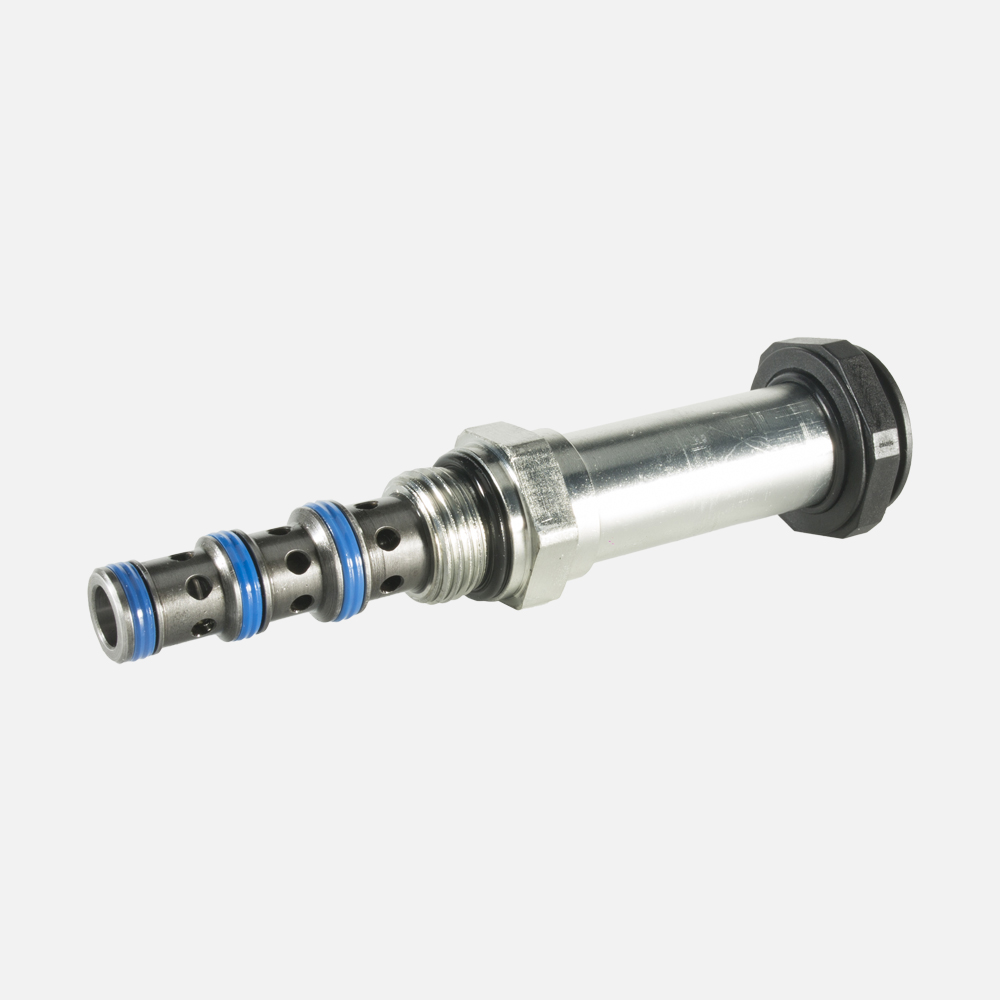
I would reject a substitution supported only by “same size, same voltage, normally closed.” It leaves the most important part of the comparison unfinished: what the hydraulic circuit actually does.
Do not let a higher pressure number decide the order
Compare operating pressure with operating pressure; proof pressure is a different test condition. The 22DH-A10 page lists an operating pressure of 207 bar and a proof pressure of 350 bar. Reading the latter as its continuous operating rating would misstate the published specification.
By contrast, Flag-up’s 24DH-B08 two-position four-way valve lists 350 bar as operating pressure and 30 L/min as flow. It also has a different directional function. Those numbers do not make it an upgraded substitute for a two-way valve.
Pressure and flow should be evaluated at the required operating point, including the active flow path. Pressure drop is the pressure lost across the valve while fluid passes through it. The loss consumes available pressure and generates heat; the acceptable value depends on the machine’s hydraulic and thermal budget.
When the available solenoid force cannot overcome the hydraulic forces at the required pressure and flow, a valve may fail to shift despite remaining below a separate static pressure limit. The relevant evidence is the operating envelope and pressure-drop curve for the selected configuration.
Specify the normal and transient port pressures, peak flow, fluid and temperature range. A proof-pressure result cannot answer whether the valve will shift repeatedly at the application’s operating point, and a free-flow demonstration cannot establish loaded performance.
The manifold decides whether “it screws in” is enough
Approve a cartridge replacement against the complete cavity drawing, not the thread designation alone. Check bore diameters, axial steps, sealing lands, port alignment and installation requirements. A correct thread can coexist with an incorrect seal location or internal passage relationship.
The manifold also affects the result after installation. Passage geometry contributes to pressure loss, and machining debris can reach sensitive moving elements. A cartridge that works on a supplier’s block may behave differently in a customer’s block with a damaged seal land or incompatible cavity.
Because cavity misalignment or excessive installation torque can restrict moving parts, an installed valve that sticks is not automatically evidence of a defective coil. HydraForce’s solenoid training manual identifies cavity alignment, installation torque and contamination among causes of failure to shift. Apply the selected manufacturer’s instructions rather than copying another brand’s torque value.
For purchasing, this changes the scope of the sample request. If the existing manifold must remain, qualification needs to include that interface. If a supplier provides the valve and block together, identify who owns cavity inspection, cleaning and assembled-function testing.
My preference is a single accountable interface owner. That does not require every operation to be internal, but it does require one party to resolve drawing conflicts instead of leaving the valve maker and manifold machinist to blame each other.
Review the electrical system after the coil warms up
Nominal voltage is only the starting point for coil selection. Record the supply type, voltage available at the coil under load, duty cycle, ambient conditions, connector and controller output. Duty cycle describes how long and how often the coil is energized.
A cold bench test with a short cable may hide a problem that appears after sustained operation in the machine. G.W. Lisk’s mobile hydraulic solenoid guidance explains that, as a voltage-driven on/off coil heats, resistance increases and current falls. Combine that with harness voltage loss and the available pull-in margin can shrink.
Because hot-coil resistance and harness voltage loss can reduce current, successful cold switching does not prove reliable hot pull-in. Pull-in is the transition into the energized position. Drop-out is the return when the electrical command is removed; both deserve application-specific checks.
The HydraForce SV12-41 datasheet illustrates the distinction by publishing a continuous-duty operating range against ambient temperature and minimum coil voltage, alongside hydraulic operating-limit curves. Use the corresponding data for the offered valve; do not transfer another model’s limits into the purchase specification.
Include connector pinout and suppression components in the approved configuration. A suppression circuit limits the voltage transient when power is removed and can affect release behavior. A changed connector with a different internal circuit therefore deserves electrical review even if its housing looks familiar.
Choose an ordinary on/off solenoid valve when the requirement is discrete switching. If the controller must continuously meter flow or regulate pressure, evaluate the appropriate proportional valve and driver together. A variable command does not turn every switching valve into a proportional device.
Judge the manufacturer’s ownership of the problem
Factory scale is useful background; the proposed engineering and quality responsibilities decide whether it supports your order. Flag-up’s company profile reports a factory exceeding 20,000 m², more than 200 employees and a 20-person R&D team. It describes applications in engineering, mining, port and lifting equipment.
For a buyer, the useful follow-up is how that organization will handle the selected valve. Identify the technical owner, the controlled drawings, the test equipment and the route from an application problem to a documented design decision. A factory photograph cannot answer these questions.
Flag-up’s product pages describe assembled-product factory testing and retention of test data. Turn that stated capability into an order requirement: define which results accompany the shipment and how those results identify the supplied configuration and production lot.
Routine factory testing and application qualification serve different purposes. Qualification investigates whether the design suits the application. Routine testing screens production against an agreed control plan; it should not be represented as a full endurance qualification of every shipped unit.
The same distinction applies to cleanliness. ISO 4406 defines a code for reporting solid-particle contamination in hydraulic fluid. It does not, by itself, select the cleanliness target for every system. Set the appropriate target for the application and distinguish operating-fluid cleanliness from the supplied component’s cleaning and packaging controls.
Make the sample order answer a purchasing decision
A useful sample test plan states what result will approve the proposed valve and what result will stop the substitution. Avoid paying for a collection of measurements that leaves the original compatibility question unanswered.
| Apparent match | Question the sample must resolve | Purchasing consequence |
|---|---|---|
| The catalog labels both valves normally closed. | Do the required paths behave correctly with power on and off? | Reject an incompatible flow map. |
| The thread fits the existing manifold. | Does the complete cavity and seal interface match? | Resolve the interface before release. |
| The pressure rating exceeds the normal load. | Does the valve shift at the required pressure, flow and backpressure? | Use the operating envelope to qualify the selection. |
| The coil switches on the bench. | Does switching remain acceptable hot and at minimum available voltage? | Approve the coil and harness conditions together. |
| The sample has acceptable leakage. | Was it measured in the required direction and fluid conditions? | Retain the test conditions with the result. |
| The supplier offers a similar connector. | Do pinout, suppression and environmental requirements match? | Control the full electrical configuration. |
Agree the test conditions and acceptance criteria before shipment. There is no universal sample quantity, leakage allowance or endurance cycle count that establishes suitability for every OEM. Loaded or safety-related circuits need the machine designer’s defined validation scope, including behavior after power loss.
For commercial comparison, align the supplied scope: cartridge alone or with coil, connector, seals, body, testing and documentation. Confirm minimum order quantity, development charges where applicable, delivery basis and spare-part availability against that exact configuration. A lower quotation may simply exclude items another offer includes.
Approve the configuration that was tested, then control changes to the parts that made it pass. Keep the drawing revision, coil code, seal specification, connector arrangement and agreed reports with the order. A retained sample is useful, but it cannot replace a controlled specification for future shipments.
Practical questions before releasing an OEM order
Is private labeling enough to define an OEM valve?
No. Identify whether the project changes only identification or also the coil, seals, cartridge geometry or hydraulic function. The validation and change-control requirements should follow that scope.
Can a manual override serve as the machine’s emergency control?
Only if the machine’s approved design assigns it that role. Override behavior varies, including whether it remains latched, so it should not be treated as an automatic substitute for a designed emergency function.
Should a distributor stock complete valves or separate coils?
Base the decision on the approved configurations and service process. Separate coils can be useful, but their compatibility must cover the actuator, electrical rating and connector arrangement rather than voltage alone.
What makes a returned failure useful to the manufacturer?
Preserve the part identity, operating conditions and symptoms, including whether the problem appears cold, hot or under load. Avoid dismantling or cleaning away evidence before agreeing the investigation method.
Does a successful sample establish production capacity?
No. Review the production route, test throughput, component supply and delivery plan separately. Design approval establishes suitability of the evaluated configuration, not an unlimited delivery commitment.
Can the buyer change hydraulic fluid after approval?
Treat a fluid change as a compatibility review. Check the selected seals, lubrication properties, viscosity and temperature conditions before extending the earlier approval.
Send Flag-up a circuit requirement, not just a photograph
A productive OEM inquiry combines the circuit diagram, controlled interface drawing and operating conditions with the required supply scope. Use Flag-up’s contact page to submit those materials, the expected order pattern and the validation questions that matter. That gives the technical team a defined basis for proposing an existing configuration or explaining why a design change is necessary.
Post time: Nov-25-2026