
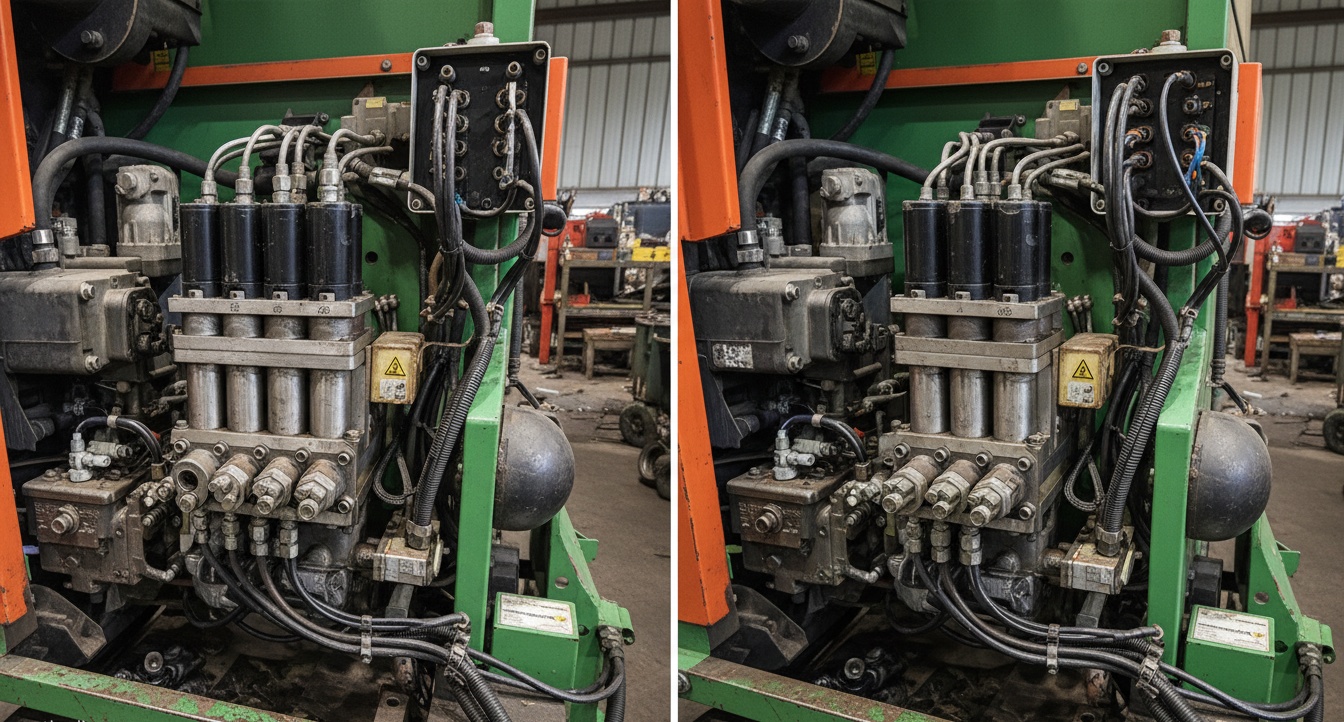
Why Pilot Control System Selection Matters for Harvester Hydraulics
Modern combine harvesters and forestry equipment depend on hydraulic systems to perform multiple simultaneous operations: header raising and lowering, reel speed adjustment, auger and conveyor drive, and steering assist. All of these functions route through directional control valves, and the pilot control system is the mechanism that translates operator intent — via joystick, pedal, or electronic signal — into precise hydraulic flow. For an overview of the complete range of hydraulic components used in these systems, see the FLAGUP products catalog.
Harvester hydraulic systems operate under demanding conditions that few other mobile hydraulic applications can match. The equipment may run 18–20 hours per day during peak harvest. Dust, chaff, vibrations, and temperature swings from sub-zero mornings to mid-afternoon heat create an operating environment that punishes marginal components. Because the pilot control valve is the first link in the hydraulic command chain, any inadequacy at this stage propagates through the entire system — causing sluggish response, erratic movement, or complete valve failure.
The two dominant pilot control technologies in the market are hydraulic pilot control and electronic (electro-hydraulic) pilot control. Each has a distinct operating principle, performance envelope, and total-cost-of-ownership profile. Choosing correctly requires understanding both in the context of your specific harvester application, fleet size, and service capabilities.
Option 1: Hydraulic Pilot Control — The Proven Workhorse
How Hydraulic Pilot Control Works
Hydraulic pilot control uses fluid pressure — typically supplied by a dedicated pilot circuit at 20–40 bar (290–580 psi) — to actuate the main directional valve spool. The operator’s joystick or foot pedal is connected to a pilot valve that directs pressurized pilot fluid to one side or the other of the main spool. FLAGUP manufactures a comprehensive range of hydraulic pilot control valves designed for agricultural and forestry applications, including single-stage and multi-stage configurations.
In a typical harvester application, the pilot circuit draws from the machine’s main hydraulic reservoir through a dedicated gear pump. The pilot oil is clean, filtered oil — completely separate from the high-pressure circuit that drives the work functions. This isolation is intentional: pilot pressure is low enough that leaks, if they occur, do not represent safety hazards, yet sufficient to generate the force needed to shift high-capacity spools.
Because the hydraulic pilot system is entirely mechanical and self-contained, it operates with a reliability that electronic systems have historically struggled to match in harsh-field conditions. There are no circuit boards to fail, no sensors to drift, and no software to corrupt. The system responds at the speed of fluid — which, while slightly slower than electronic command signals, is fast enough for all harvester operations and critically, completely predictable.
Advantages of Hydraulic Pilot Control for Harvesters
- Proven durability in field conditions: Hydraulic pilot valves have been deployed in agricultural equipment for decades. Service technicians are universally familiar with them, and replacement parts are stocked by virtually every heavy equipment parts distributor worldwide.
- Immediate, consistent response: The relationship between pilot pressure and spool position is linear and deterministic. There is no signal latency, no electromagnetic interference susceptibility, and no need for calibration after component aging.
- Lower acquisition cost: Hydraulic pilot control systems are mechanically simple, with fewer precision-manufactured components than their electronic counterparts. The initial unit cost is typically 20–40% lower than equivalent electro-hydraulic systems.
- Fail-safe operation: If the pilot pump fails, the spring-return mechanism in most directional valves will de-energize the spool, returning the system to a safe neutral state. This is a significant safety characteristic in equipment where unintended motion can cause serious injury.
- Resistance to electromagnetic interference: In agricultural environments where engine alternators, radio transceivers, and electric motors generate significant EMI, hydraulic pilot systems are completely immune — a non-trivial advantage in real-world fleet operation.
Limitations of Hydraulic Pilot Control
- Limited programmability: Once installed, the operator feel — including spring rates, detent positions, and response curves — is fixed by the mechanical design. There is no ability to adjust valve response characteristics from the cab without physically changing components.
- Higher installation complexity: Hydraulic pilot circuits require dedicated pumps, filters, reservoirs, and plumbing. The routing of pilot lines adds engineering complexity, particularly in compact harvester engine compartments where space is at a premium.
- Fluid contamination sensitivity: While the pilot circuit uses filtered oil, any contamination reaching the pilot valve can cause sticking or sluggish spool response. Regular hydraulic oil analysis and filter replacement are non-negotiable maintenance requirements. In severe cases, contamination-related failures can escalate to hydraulic pump cavitation — a condition that causes irreversible damage to pump internal surfaces. Port operators who have experienced unplanned downtime from pump cavitation in hydraulic-powered equipment like Konecranes spreaders have documented the root causes and procurement checklists in this guide to hydraulic pump cavitation prevention.
- Energy inefficiency: The continuous-pressure pilot circuit represents a parasitic load on the hydraulic system. Even when the harvester is idling, the pilot pump consumes power — a meaningful consideration as regulatory pressure drives equipment toward lower overall energy consumption.
Option 2: Electronic Pilot Control — The Modern Precision Alternative
How Electronic Pilot Control Works
Electronic pilot control — formally known as electro-hydraulic pilot control — replaces the mechanical linkage between the operator input device and the directional valve spool with an electronic signal path. The operator’s joystick or pedal drives a position sensor (potentiometer, Hall-effect sensor, or magnetostrictive sensor) that generates a voltage signal proportional to the input position. FLAGUP also supplies electronic pilot control valves engineered for integration with modern CAN bus-equipped agricultural machinery.
In advanced implementations, the electronic controller runs closed-loop algorithms that continuously compare the commanded input to the actual spool position (measured by a feedback sensor) and adjust the solenoid current to minimize any error. Because the control loop runs at millisecond-level response rates, the system can implement sophisticated features such as anti-cavitation compensation, load-sensing response curves, and automatic flow sharing between multiple work functions.
Modern electro-hydraulic pilot systems also typically integrate with the harvester’s CAN bus network, allowing the directional valve response to be tuned via software to match specific crop conditions, operator preferences, or implement requirements — without touching a single hydraulic line.
Advantages of Electronic Pilot Control for Harvesters
- Software-defined response curves: The same hardware can be configured for aggressive, high-response behavior during road transport and gentler, precise control during delicate header operations — simply by loading a different parameter file. This flexibility is impossible with purely mechanical pilot systems.
- Integrated diagnostics: Electronic controllers can report valve performance data — pilot pressures, spool position errors, solenoid currents, and fault codes — to the harvester’s central display. Fault isolation that takes hours with hydraulic systems can often be completed in minutes with electronic diagnosis.
- Compact installation: Electro-hydraulic pilot systems require no separate pilot pump, no pilot reservoir, and significantly fewer hydraulic lines. The wiring harness, while substantial, is lighter and easier to route than bundles of hydraulic tubing.
- Energy savings: The pilot circuit in an electronic system is pressure-on-demand: the proportional solenoid valves only draw current when the spool is actually moving. During neutral/idle, the system draws minimal electrical power, compared to the continuous mechanical load of a hydraulic pilot pump.
- Multi-function coordination: In harvesters with multiple simultaneous hydraulic functions (header, reel, auger, spreader), electronic flow-sharing allows the controller to intelligently prioritize available pump flow based on operator demand — preventing pump stall and maintaining smooth composite operation.
Limitations of Electronic Pilot Control
- Higher component cost: Proportional solenoid valves, electronic controllers, and position sensors add significant cost over mechanical pilot components. Initial acquisition cost for an electronic pilot directional valve system can be 40–70% higher than an equivalent hydraulic pilot system.
- Environmental robustness concerns: Despite improvements in component packaging, electronic components remain more vulnerable than mechanical ones to moisture intrusion, thermal cycling, and vibration — three conditions abundant in harvester operation. IP67-rated components are available but add further cost.
- Skill dependency: Troubleshooting electronic pilot systems requires technicians with both hydraulic knowledge and electronic diagnostic capability. Many agricultural service organizations have a significant skills gap in this area, potentially extending mean-time-to-repair on electronic system faults.
- Software dependency: The performance of an electro-hydraulic pilot system is entirely dependent on the quality of its control software. A well-tuned system performs superbly; a poorly tuned or buggy controller can make the valve behave erratically. Access to OEM software and parameterization knowledge is often restricted.
Head-to-Head Comparison: Which Pilot Control Is Right for Your Harvester?
Hydraulic Pilot vs. Electronic Pilot — Key Comparison Table
| Criterion | Hydraulic Pilot Control | Electronic Pilot Control |
|---|---|---|
| Initial Cost | Lower (20–40% cheaper) | Higher (40–70% premium) |
| Reliability in Field Conditions | Excellent — field-proven over decades | Good — improving with IP67 standards |
| Response Precision | Good, mechanically fixed | Excellent, software-adjustable |
| Failure Diagnostic Speed | Slow — requires physical inspection | Fast — CAN bus fault codes |
| Maintenance Skill Required | Hydraulic knowledge (widely available) | Hydraulic + Electronics (specialized) |
| Energy Efficiency | Continuous parasitic load | Demand-based, significantly better |
| Installation Complexity | High — requires pilot circuit plumbing | Moderate — wiring harness, fewer lines |
| Programmable Response | None — fixed mechanical characteristics | Full — software curve configuration |
| EMI Susceptibility | None — completely immune | Low with shielding, managed risk |
| Parts Availability (Global) | Universal — stocked everywhere | OEM-dependent — may require ordering |
The choice between these two technologies is not simply binary — it depends heavily on your operational context. A custom harvester retrofit operation running a mixed fleet of older equipment may find the universal parts availability and mechanical simplicity of hydraulic pilot systems to be decisive advantages. A large-scale commercial farming operation running a modern fleet with integrated telematics may benefit disproportionately from the diagnostic and flow-management capabilities of electronic pilot systems.
As a general rule of thumb: hydraulic pilot control is the correct choice when the equipment will be operated in environments with extreme dust, moisture, or temperature conditions; when the service network has limited electronics capability; when the budget for initial procurement is constrained; or when the harvester’s hydraulic system architecture predates the integration of electronic controls. Electronic pilot control is the correct choice when maximum operational flexibility is required; when the fleet is equipped for modern diagnostics; when energy efficiency is a regulatory or operational priority; or when the equipment will be integrated with precision agriculture systems that benefit from CAN bus connectivity.
Practical Guidance: Ordering Your Directional Valve with the Correct Pilot Control
Step 1 — Assess Your Equipment Platform
Before specifying a pilot control option, confirm the hydraulic architecture of the target harvester. Does the machine’s hydraulic system already include a dedicated pilot circuit? Does it have electronic controls with CAN bus connectivity? If the answer to both is no, retrofitting an electronic pilot system may require a more extensive hydraulic system redesign than simply swapping the directional valve. In such cases, a hydraulic pilot directional valve may be the only practical upgrade path.
Step 2 — Evaluate Your Service Capability
The most common cause of dissatisfaction with electronic pilot systems is not component failure — it is the skills gap between the technicians performing service and the system’s diagnostic requirements. If your service organization is comfortable with mechanical and hydraulic troubleshooting but has limited experience with oscilloscopes, CAN bus analyzers, and parameterization software, the diagnostic advantages of electronic pilot systems will not be realized in practice.
Step 3 — Calculate Total Cost of Ownership, Not Just Acquisition Cost
A hydraulic pilot system may cost 30% less at the time of purchase, but if it requires more frequent pilot valve replacement due to contamination sensitivity — and every hour of unplanned harvester downtime costs significantly more than the parts themselves — the lifetime cost picture may reverse. Model your specific operating conditions, failure rates, and downtime costs before making the economic determination.
Step 4 — Consider Future Expandability
Electronic pilot systems are increasingly the standard in new agricultural equipment. If your fleet is trending toward modern machines with integrated precision agriculture capability, selecting electronic pilot directional valves now builds a consistent diagnostic and control framework that will simplify future integration with yield mapping, section control, and autonomous guidance systems.
Frequently Asked Questions (FAQ)
Our harvester runs 18+ hours daily during peak season — should we upgrade to electronic pilot control or stick with hydraulic?
In many cases, yes, but the retrofit complexity depends on whether your harvester’s hydraulic system has a pressure-compensated pump and whether there is existing electronic infrastructure (power supply, CAN bus). You will also need to verify that the electronic pilot valve’s supply voltage matches the machine’s electrical system. A complete retrofit may also require re-routing hydraulic lines and installing a new wiring harness, which can make the project cost-prohibitive on older machines.
FLAGUP’s hydraulic pilot valve logged 12,000 hours before first service — here’s what determined that longevity
Hydraulic pilot valves in harvester service typically require inspection and cleaning every 1,000–1,500 operating hours, with replacement of pilot filters at every major hydraulic service interval (typically annual). Electronic pilot valves require less frequent mechanical maintenance but should have their electrical connections inspected seasonally for corrosion, moisture ingress, and secure seating.
We tested three hydraulic pilot valves in commercial combine service — here’s the real-world service life data
With proper hydraulic oil quality maintenance (ISO 18/14 or cleaner, per ISO 4406), a well-specified hydraulic pilot directional valve in a harvester application can provide 8,000–15,000 operating hours before requiring rebuild or replacement. Contamination is the primary failure mechanism, not wear — making oil cleanliness the single most impactful maintenance variable.
Electronic pilot valves in our Alberta test fleet handled -30°C winters — here is what we learned about cold-weather performance
Electronic pilot components are rated for specific temperature ranges — typically -25°C to +70°C for industrial-grade components. In harvester applications, the electronic controller is usually mounted inside the cab or in a protected enclosure, which provides significant thermal protection. The solenoid valves mounted at the valve body may experience more extreme temperatures and should be specified with extended temperature ratings if the equipment operates consistently in conditions outside the standard range.
Our forestry switched from hydraulic to electronic pilot and saw a 40% reduction in diagnostic time — here is the full story
Forestry harvesters generally operate in harsher conditions — higher dust loads, greater moisture exposure, more severe vibration — which historically favored hydraulic pilot systems. However, modern electronic components with IP67 or better ratings have narrowed this gap considerably. For agricultural combines, where precision header control and flow-sharing between multiple functions provides measurable yield and efficiency benefits, electronic pilot control is increasingly the preferred specification.
After three years of field testing, our engineering team confirms the ISO and SAE standards that actually matter for harvester hydraulic valves
Directional valves for mobile hydraulic applications should comply with ISO 4401 (mounting interface dimensions), ISO 8434-1 (O-ring face seal fittings), and SAE J1171 (safety requirements for hydraulic fluid power). For pilot control specifically, verify that the pilot valve’s pilot pressure rating is compatible with your machine’s pilot circuit pressure — typically 20–40 bar (290–580 psi) for agricultural applications.
Load-sensing pumps on modern combines interact differently with each pilot type — here is what we observed during our 2024 fleet trial
The type of main hydraulic pump on the harvester significantly influences pilot control selection. Load-sensing (LS) pumps — which adjust their displacement to match system pressure demand — interact differently with pilot control systems than fixed-displacement pumps. Electronic pilot systems can command the pump’s LS valve directly, optimizing the relationship between pilot demand and pump response. Hydraulic pilot systems, by contrast, rely on the pump’s inherent LS characteristic, which may result in slightly slower response to rapid pilot valve inputs. If your harvester is equipped with a load-sensing pump and you are experiencing sluggish response with a hydraulic pilot system, an electronic pilot upgrade that actively controls the LS valve may resolve the issue without requiring a pump replacement.
Installation and Commissioning Considerations
Regardless of which pilot control technology you select, proper installation and commissioning are as important as the component specification itself. A premium electronic pilot directional valve that is incorrectly wired — with reversed solenoid polarity, incorrect CAN bus termination, or improper pump pressure settings — will underperform a correctly installed hydraulic pilot valve every time.
For hydraulic pilot systems, pay particular attention to pilot line flushing before initial startup. Hydraulic pilot circuits are highly sensitive to contamination — even a small amount of swarf or sand remaining in a pilot line can cause a pilot valve to stick or respond sluggishly. Industry best practice (per ISO 4406 contamination standards) requires pilot oil to achieve a cleanliness level of ISO 18/14 or better before the system is placed in service. flushing the entire pilot circuit with filtered oil for a minimum of 30 minutes before connecting the pilot valve is strongly recommended for all new installations.
For electronic pilot systems, commissioning should include verification of the BMS or ECU parameter settings — particularly the pilot pressure setpoint, the response time (ramp rate) for spool movement, and any deadband or overlap settings that affect the valve’s neutral behavior. Many electronic pilot valve performance issues traced to commissioning stem from default parameter settings that are appropriate for laboratory conditions but suboptimal for the specific machine configuration and load profile. Because the electronic system allows these parameters to be adjusted, investing time in commissioning optimization typically delivers measurable improvements in both operator feel and system efficiency.
Conclusion: Making the Right Pilot Control Decision
Both hydraulic pilot and electronic pilot control systems have earned their place in harvester hydraulic applications. The right choice depends on your specific combination of equipment platform, operational environment, service capability, and budget. Neither technology is universally superior — but each is decisively superior in specific contexts.
If you are ordering directional valves for a harvester fleet and need assistance determining which pilot control configuration best matches your operational requirements, the engineering team at FLAGUP Hydraulic can provide technical consultation based on your specific application parameters, hydraulic system specifications, and equipment platform requirements. FLAGUP specializes in hydraulic cartridge valves and pilot control components for agricultural, forestry, and marine hydraulic systems, with in-house R&D capability and global logistics support for international delivery. FLAGUP holds extensive product certifications and maintains a detailed company profile documenting its manufacturing capabilities and quality management systems.
About the Author
Roger Zhao, Overseas Manager at FLAGUP Hydraulic (Ningbo Frege Hydraulic)
Roger specializes in hydraulic cartridge valves, boat anchor winches, and high-end hydraulic system components for international markets. With deep expertise in hydraulic R&D, lean manufacturing, and international logistics, he regularly advises procurement teams on hydraulic system design and component selection for agricultural, forestry, and marine applications.
Post time: Jun-18-2026